The Monk in the Window: Education, Faith, Wi-Fi, and the Freedom of My Mind
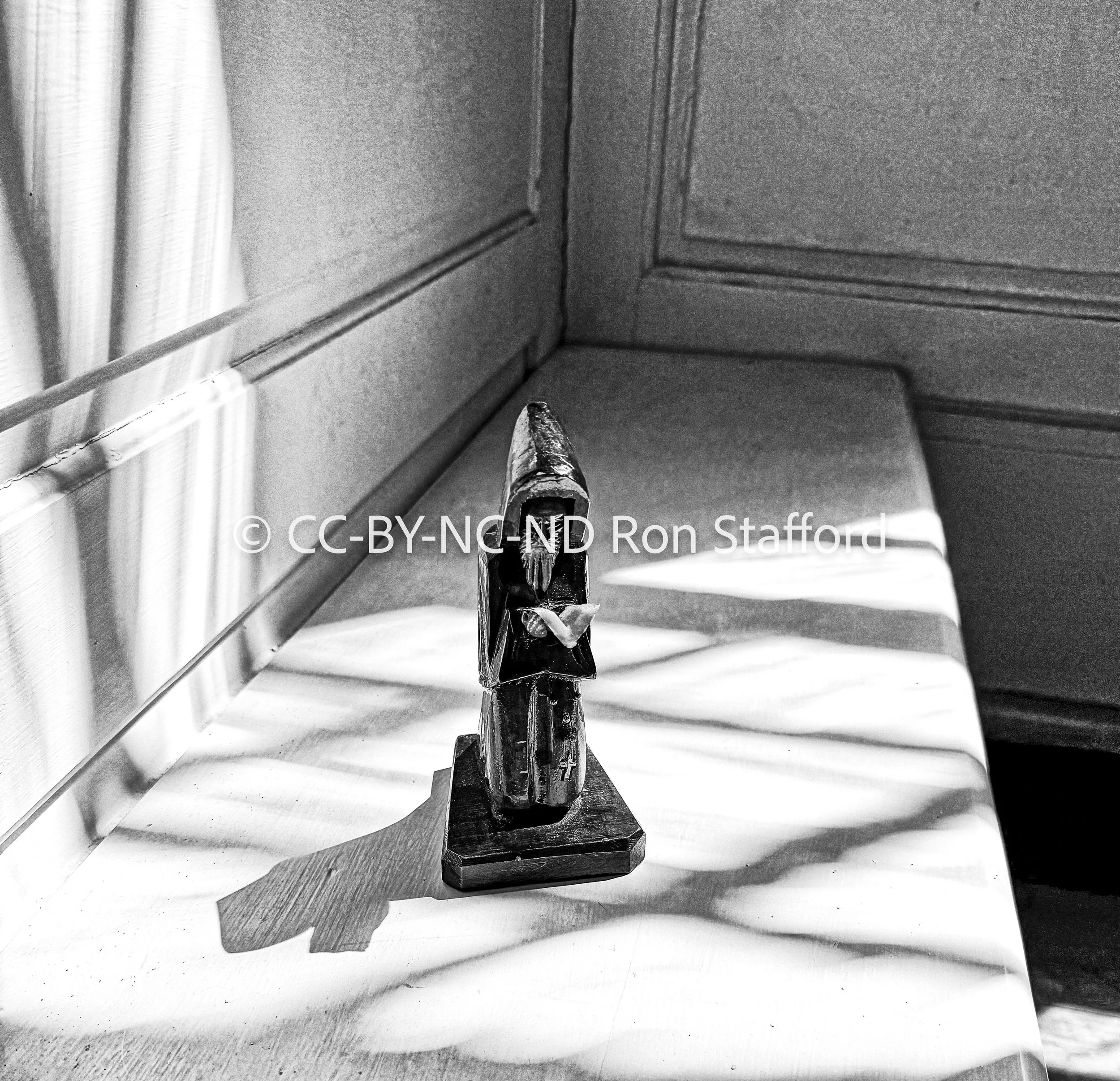
A monk, a book, and a little light—basically my whole personality in one photo.
Faith, learning, libraries, and the stubborn freedom of the mind.
Photo by Ron Stafford
There are some photographs that accidentally preach better than half the sermons I have written.
This little monk, standing in a wash of window light with his book tucked close, looks like he has just finished reading Thomas Aquinas, survived a faculty meeting, and is now silently judging everyone who misuses the word “rigor.” In other words, I feel deeply represented.
I have always had a fondness for education and religion because, to me, they have never been separate rooms in the house of my life. They are more like adjoining libraries, and yes, Virginia Woolf has entered the chat. Woolf famously wrote, “Lock up your libraries if you like; but there is no gate, no lock, no bolt that you can set upon the freedom of my mind” (Woolf, 1929/1989, p. 76). That line has always felt personal to me. Very personal. Possibly “engrave it on my academic goblet” personal.
Because that is what education does when it is at its best. It refuses to let the mind be locked up.
And that is also what faith does when it is healthy, deep, and properly rooted. It opens the mind rather than closing it. It gives the soul a vocabulary. It teaches us that knowledge is not simply information stacked neatly like books on a shelf. Knowledge is formation. It is discipline. It is humility. It is wonder. It is the holy audacity of believing that the human mind was made to seek truth, not merely to pass quizzes, complete modules, and remember yet another password that must include one capital letter, one number, one symbol, and the blood of a minor prophet.
This is where Thomas Aquinas matters so much to me.
In the Summa Theologica, Aquinas approaches truth with reverence and method. He asks a question. He considers objections. He gives space to disagreement. Then he answers with clarity, reason, and faith. Honestly, Aquinas was basically running a graduate seminar centuries before discussion boards started asking everyone to “reply to two classmates by Sunday at midnight.” But unlike many discussion boards, Aquinas had something to say.
For Aquinas, faith and reason are not enemies. They are companions. Reason helps us think carefully. Faith helps us see more deeply. The mind matters because God made it. The soul matters because we are not machines. The search for truth matters because truth is not a trend. Truth is eternal, and we are formed by seeking it (Aquinas, 1947).
That is why I find myself drawn to Perennialism as a philosophy of education. Perennialism argues that education should focus on enduring truths, the great questions, and the wisdom that survives the fashions of the age. It says, in effect, that while the tools of learning may change, the purpose of learning does not. We may move from parchment to print, from chalkboards to smartboards, from card catalogs to databases, from dusty stacks to digital repositories, but the core questions remain: What is true? What is good? What is beautiful? What does justice require? What does it mean to live well? What do we owe one another?
Those questions do not expire like software licenses.
This is also where my own dissertation work comes into the picture, probably wearing sensible shoes and carrying too many citations. My research on the digital divide and rural community college persistence was about internet access, yes. But it was never only about internet access. It was about students who were trying to pursue education while the very systems designed to help them often assumed they had resources they did not actually possess.
That is the great trouble with modern education and technology. We love to say technology expands access. And it can. I believe that deeply. I have spent much of my professional life working with digital libraries, open educational resources, online learning support, virtual reference, and academic technologies that can genuinely help students. Technology can bring the library to the student who cannot physically get to campus. It can reduce textbook costs. It can make learning more flexible for adult students balancing work, caregiving, illness, transportation problems, and life in all its messy glory.
But technology can also become a locked door with better branding.
Modern educational theories that focus on technology and learning remind us that access is not one simple thing. It is layered. Students need devices, broadband, digital skills, confidence, time, support, and a learning environment designed with their actual lives in mind. Digital divide theory, technology acceptance models, online learning readiness, and frameworks for digital learning all point toward one basic truth: a student cannot benefit from a system they cannot meaningfully enter.
My dissertation centered on nontraditional students in rural Southern technical colleges, especially those whose limited or unreliable internet access shaped their enrollment, retention, and academic persistence. These students were not lazy. They were not unwilling. They were not allergic to success, despite what some people’s very tired assumptions might suggest. They were often working, caregiving, commuting, managing bills, dealing with spotty service, and trying to complete coursework in conditions that would make even St. Thomas Aquinas mutter something in Latin.
And yet, they persisted.
That is where the moral question appears.
If education is formation, and if education is supposed to open the life of the mind, then we cannot ignore the conditions under which students are asked to learn. It is not enough to say, “The course is online.” It is not enough to say, “The resources are available.” Available to whom? Under what conditions? With what level of access? With what support? With what assumptions?
A learning management system is not automatically justice.
A Wi-Fi signal is not automatically opportunity.
A digital textbook is not automatically access.
Perennialism helps me hold all of this together because it keeps the eternal questions at the center. Technology is important, but it is not the center. The student is. The human person is. The pursuit of truth is. The formation of the mind and soul is. Aquinas reminds me that education must be ordered toward the good. Woolf reminds me that the freedom of the mind cannot be contained by gates, locks, or bolts. My dissertation reminds me that while the mind may be free, the student still needs a reliable internet connection, a working device, and an institution that understands that “just log in” is not a pedagogy.
That last sentence may need to be cross-stitched on a pillow and mailed to every college committee in America.
For me, the relationship between education and religion is not sentimental. It is foundational. Religion gives education its moral imagination. Education gives religion discipline, language, memory, and intellectual depth. Together, they resist the reduction of human beings into numbers, outcomes, dashboards, and reports that someone will inevitably turn into a color-coded spreadsheet.
Do not misunderstand me. I appreciate a good spreadsheet. I am not a monster.
But students are not spreadsheets.
Students are souls in motion.
They are minds being formed. They are stories unfolding. They are people carrying invisible burdens into classrooms, libraries, advising offices, and online spaces. Some of them are one missed paycheck, one dropped signal, one broken laptop, one illness, or one family emergency away from stopping out. If education does not see that, then education has become efficient without becoming wise.
And wisdom is the thing I keep coming back to.
Aquinas sought wisdom through faith and reason. Woolf claimed the freedom of the mind against exclusion and limitation. Perennialism insists that some truths remain worth teaching no matter how modern we become. My own work in higher education and digital equity has convinced me that the future of learning must be technologically aware, but morally grounded. We need the tools, yes. We need broadband, devices, platforms, open resources, and well-designed digital learning. But we also need purpose. We need justice. We need hospitality. We need the courage to ask whether our systems are serving students or merely sorting them.
That is why this little monk in the window speaks to me.
He stands in stillness, but not in retreat from the world. He is holding a book, or perhaps a prayer, or perhaps the minutes from a committee meeting he is spiritually preparing to endure. The light falls around him like grace. The shadows stretch behind him like history. He is small, but he is serious. He reminds me that learning is sacred work. He reminds me that silence can be productive. He reminds me that the mind needs both a room and a window.
And perhaps that is my whole educational philosophy in one sentence: give students a room, a window, a library, a signal, and the freedom to become.
Education should not simply train workers. It should form persons. It should teach people to read deeply, think carefully, argue honestly, pray humbly if they are so inclined, and live more justly. It should help students recognize that their minds matter. Their questions matter. Their futures matter. Their access matters.
So yes, I love education. I love religion. I love Aquinas and Woolf and libraries and learning and all the strange holy machinery of the mind. I even love technology when it behaves itself and remembers that it is supposed to serve human beings, not replace them.
But most of all, I love the idea that no gate, no lock, no bolt, no bad Wi-Fi signal, no institutional foolishness, no inaccessible system, and no small-minded view of education gets the final word over the freedom of the mind.
Lock up the libraries if you like.
I know a monk by the window who is still reading.
And frankly, so am I.
References
Aquinas, T. (1947). Summa theologica (Fathers of the English Dominican Province, Trans.). Benziger Bros. Original work published ca. 1265–1274.
Woolf, V. (1989). A room of one’s own. Harcourt Brace Jovanovich. Original work published 1929.