What Will I Do Without Euridice? Gluck, Orpheus, and the Ruinous Mercy of Looking Back
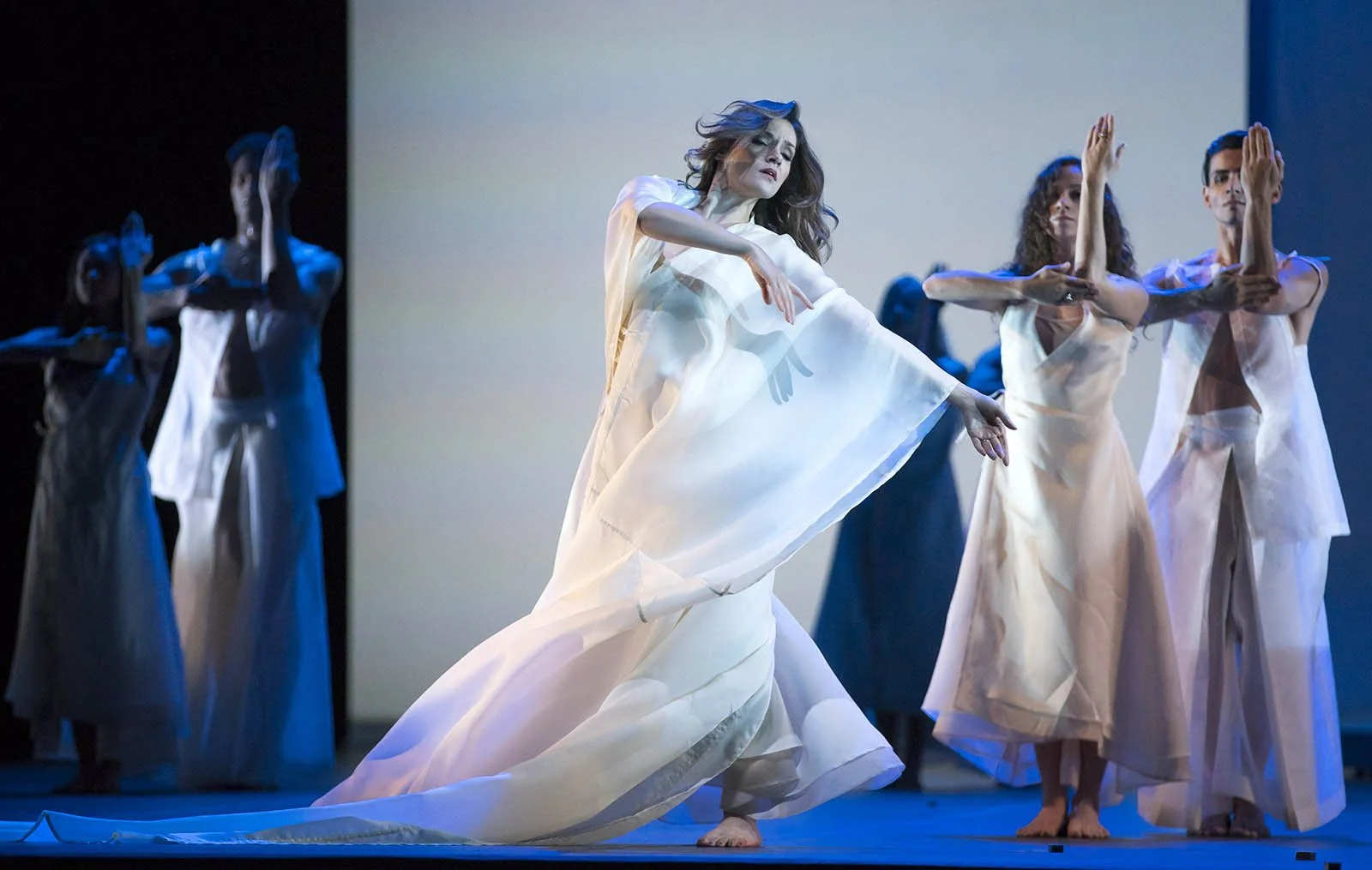
Eurydice moves like a soul caught between worlds—half body, half breath, suspended in blue light and white fabric. In this image from Lyric Opera of Chicago’s Orphée et Eurydice, she becomes the very thing Orpheus cannot bear to trust: love present, but unseen; near, but not yet safe. (Lyric Opera of Chicago, n.d.)
Watch the video before you read this post:
https://youtu.be/2BjCvWvg0So?si=CSiYoGGQS1QbaMi8
There are some pieces of music that do not merely sound beautiful. They expose us. They place a mirror before the soul and say, with terrifying gentleness, here is where you lost courage. Here is where you looked back. Here is where love became fear.
Christoph Willibald Gluck’s aria “Che farò senza Euridice?” from Orfeo ed Euridice is one of those pieces. The title translates as “What will I do without Euridice?” On the surface, it is a lament. Orfeo has lost his wife twice: first to death, and then to his own inability to trust the command that would have restored her to him. But beneath the sorrow of the aria is something even more devastating than grief. It is the knowledge that he participated in the loss. Not because he hated her. Not because he forgot her. Not because he lacked love. He lost her because he doubted.
That is what makes the myth almost unbearable. Orpheus does not look back out of cruelty. He looks back because love, when wounded by fear, often disguises doubt as tenderness. He wants to make sure she is there. He wants proof. He wants reassurance. He wants the visible, touchable, immediate certainty that she is following him. But the divine condition is clear: he must lead Euridice out of the Underworld without looking at her. In Virgil and Ovid’s classical versions of the myth, the backward glance becomes the fatal gesture: the lover who has almost conquered death loses everything at the threshold because he cannot endure not knowing (Ovid, trans. 2004; Virgil, trans. 2009).
And is that not one of the most human things ever placed in myth?
We often imagine doubt as an intellectual problem, something seated politely in the mind, wearing spectacles and asking questions in a seminar room. But doubt is rarely that civilized. Doubt is bodily. It tightens the chest. It quickens the hand. It whispers, Check again. Ask again. Look again. Make sure. What if you are wrong? What if she is gone? What if God has not kept His promise? What if love has failed?
Orpheus is not simply a tragic singer. He is the patron saint of the almost-faithful, the almost-healed, the almost-free. He is the soul that has walked through hell, heard the gates open, felt hope return, and then, just before daylight, turns around because trust feels too dangerous.
Gluck understood this with astonishing restraint. Orfeo ed Euridice, first performed in Vienna in 1762, is often described as one of the great reform operas. Gluck sought to move opera away from excess and empty display toward dramatic truth: music, poetry, and movement joined together in service of the human situation (Metropolitan Opera, 2024). In other words, Gluck did not want ornament for ornament’s sake. He wanted music to tell the truth.
That truth becomes especially piercing in “Che farò senza Euridice?” The aria arrives in Act III, immediately after Orfeo breaks the condition. Euridice, unable to understand why her husband will not look at her or comfort her, panics. Her confusion becomes anguish. Orfeo, tormented by her suffering, turns. She dies again. The Met’s program notes describe this moment as the crux of the opera: the second death leads directly and seamlessly into Orfeo’s most famous aria of grief (Bedell, 2024).
What is so astonishing is that Gluck sets this devastation in C major. That detail always catches me. C major is often heard as clear, bright, open, almost innocent. It is not the obvious key of collapse. One expects darkness, storm, chromatic sobbing, something musically draped in black. But Gluck gives us simplicity. He gives us a melody so clear that it almost seems cruel. The grief does not thrash. It stands still.
That, to me, is the genius of the aria. Grief at its deepest level is not always loud. Sometimes it is terribly plain. Sometimes it is a single room after everyone has left. Sometimes it is the chair where someone used to sit. Sometimes it is the sentence we cannot stop repeating I have lost my Euridice. There is no more hope for me. I am undone.
The music does not tell us that Orfeo is merely sad. It tells us that he has entered the awful clarity that follows irreversible action. There are griefs that we suffer, and there are griefs that accuse us. This aria belongs to the second kind. It is not simply “my beloved is gone.” It is “my beloved is gone, and my own fear helped take her from me.”
That is why the myth continues to trouble us. Orpheus had already done the impossible. His song moved the powers of the Underworld. His art softened the realm of death. His love crossed a boundary no ordinary human being could cross. And yet the final test was not strength, beauty, talent, or even devotion. The final test was trust.
That is a sobering thing. Many of us can survive the descent. We can endure the hospital room, the diagnosis, the betrayal, the loneliness, the season of loss, the long corridor of uncertainty. We can sing in the Underworld if we must. We can become brave when there is no other option. But when the door begins to open, when hope begins to return, when we are asked to walk forward without constantly checking whether everything is secure behind us, that is often where doubt defeats us.
Psychology gives language to what myth and music already knew. Doubt is not always pathological; some doubt is adaptive. It helps us pause, evaluate, and avoid foolish certainty. But excessive doubt can impair decision-making, slow evidence-gathering, and create a craving for reassurance that never fully satisfies (Naaz et al., 2021). Researchers have also studied “intolerance of uncertainty,” the difficulty some people experience when key information is missing. This intolerance is associated with anxiety, worry, avoidance, and the need to reduce ambiguity at almost any cost (Gentes & Ruscio, 2011; Carleton, 2016).
In other words, Orpheus’ backward glance is not ancient superstition. It is psychologically recognizable. He cannot tolerate the unseen. He cannot live, even for a few more steps, with the possibility that Euridice is behind him but unavailable to his eyes. He has a promise, but he wants proof. He has a command, but he wants control. He has hope, but he wants certainty.
And here is the terrible irony: certainty becomes the instrument of loss.
That is what doubt often does in our lives. It pretends to protect us, but it slowly trains us to mistrust the very road that is saving us. It tells us to look back, not once, but repeatedly. Look back at the old wound. Look back at the old failure. Look back at the person who left. Look back at the version of yourself that did not survive intact. Look back at the fear and call it wisdom. Look back until you cannot walk forward anymore.
There is a difference between memory and captivity. Memory honors what has happened. Captivity keeps us chained to it. Orpheus’ tragedy is that he cannot let the unseen remain unseen long enough for redemption to complete its work. His love is real, but his doubt interrupts resurrection.
That sentence frightens me because it applies to more than opera.
How many times do we lose peace because we keep checking whether peace is still there? How many times do we lose trust because we keep demanding that trust prove itself before we will practice it? How many times do we sabotage healing because the old fear feels more familiar than the new mercy?
The backward glance is not always dramatic. Sometimes it is rereading the message ten times. Sometimes it is assuming silence means rejection. Sometimes it is needing constant confirmation that we are loved, wanted, forgiven, capable, safe. Sometimes it is revisiting the old shame until it feels more authoritative than grace. Sometimes it is standing at the edge of a new life and saying, but what if I cannot trust it?
Orpheus’ problem is not that he loves Euridice too much. It is that his love has not yet been purified of possession. He wants her returned, yes, but he wants her returned in a way he can manage. He wants love without uncertainty, restoration without obedience, resurrection without patience. That is not wicked. It is human. But it is also dangerous.
Gluck’s C major makes this more haunting. The brightness of the music suggests that Orfeo’s grief has passed beyond theatrical despair into something almost transcendent. The aria does not wallow. It reveals. The simplicity becomes a kind of spiritual x-ray. We hear a soul stripped of argument. No more bargaining. No more heroic descent. No more lyre strong enough to charm death. Only the question: What will I do without Euridice?
That question is not only romantic. It is existential. What will I do without the thing I thought I could not live without? What will I do without the version of my life I expected? What will I do without the person, the plan, the body, the certainty, the future, the innocence, the old map?
And perhaps the even deeper question is this: What will I do after doubt has cost me something?
The myth does not let us escape into easy comfort. In many versions, Orpheus is not immediately restored to joy. He becomes the singer of loss. His art is marked by what he could not keep. That may be why the Orpheus myth has endured so powerfully in Western art, literature, and music. It asks whether beauty can survive failure. It asks whether song can remain after the beloved is gone. It asks whether the artist’s gift is enough when the artist himself is broken.
For Gluck, the answer is complicated by opera’s need for resolution. In Orfeo ed Euridice, Amor ultimately intervenes, and Euridice is restored. The opera gives us grace where the older myth gives us devastation. But even that happy ending does not erase the aria. The wound has already sung. Orfeo has already stood in the bare place and asked what remains when love and hope seem lost.
That is why “Che farò senza Euridice?” is more than a beautiful aria. It is a spiritual examination. It asks us to consider where doubt has taught us to look backward instead of forward. It asks us to name the places where we confuse vigilance with wisdom, control with care, reassurance with faith. It asks us whether we can keep walking when we cannot see everything we love.
There is a holy discipline in not looking back. Not because the past does not matter. It does. The past forms us, wounds us, teaches us, and sometimes blesses us. But there are moments when looking back is no longer remembrance. It is refusal. It is fear dressed as fidelity. It is the soul saying, I will not go forward unless I can drag certainty with me.
Faith, at its deepest, is not the absence of doubt. It is the decision not to let doubt become lord. It is walking toward the light while every anxious nerve in the body begs for one more look. It is trusting that what follows behind us does not need to be constantly inspected to be real. It is learning that love cannot be resurrected by control.
Orpheus looked back because he wanted to make sure Euridice was there. I understand him. I think most of us do. That is the awful tenderness of the myth. His failure is not alien to us. It is painfully familiar. We, too, have looked back when we should have walked on. We, too, have doubted the promise because the silence behind us felt unbearable. We, too, have asked for proof when what was required of us was trust.
And yet Gluck leaves us with music. That matters. Even after the failure, there is an aria. Even after the second death, there is beauty. Even after doubt has done its damage, the soul can still sing.
Perhaps that is the mercy hidden inside “Che farò senza Euridice?” The aria does not deny ruin. It sings from within it. It teaches us that grief can be clear, simple, and almost luminous. It teaches us that the most devastating question may also become the beginning of prayer.
What will I do without Euridice?
What will I do without certainty?
What will I do now that I have looked back and cannot undo it?
Maybe the first answer is simply this: I will tell the truth. I will stop pretending doubt saved me. I will grieve what fear has cost me. And then, by whatever mercy remains, I will learn to walk forward again.
Video Referenced
Gluck, C. W. (Composer). (n.d.). Orfeo ed Euridice: “Che farò senza Euridice?” [Video]. YouTube. https://www.youtube.com/watch?v=2BjCvWvg0So
References
Bedell, J. E. (2024). Program notes for Orfeo ed Euridice. Metropolitan Opera. https://www.metopera.org/globalassets/season/2023-24/orfeo-ed-euridice/programs/052524-orfeo-ed-euridice.pdf
Carleton, R. N. (2016). Fear of the unknown: One fear to rule them all? Journal of Anxiety Disorders, 41, 5–21. https://doi.org/10.1016/j.janxdis.2016.03.011
Gentes, E. L., & Ruscio, A. M. (2011). A meta-analysis of the relation of intolerance of uncertainty to symptoms of generalized anxiety disorder, major depressive disorder, and obsessive-compulsive disorder. Clinical Psychology Review, 31(6), 923–933. https://doi.org/10.1016/j.cpr.2011.05.001
Lyric Opera of Chicago. (n.d.). Orphée et Eurydice (Orpheus and Eurydice) [Photograph]. https://www.lyricopera.org/shows/upcoming/2017-18/orphee-et-eurydice/
Metropolitan Opera. (2024). Orfeo ed Euridice. https://www.metopera.org/user-information/old-seasons/2023-24-season/orfeo-ed-euridice/
Naaz, F., Chen, L., Gold, A. I., Samuels, J., Krasnow, J., Wang, Y., Nestadt, P., Kamath, V., Chib, V. S., Nestadt, G., & Bakker, A. (2021). Neural correlates of doubt in decision-making. Psychiatry Research: Neuroimaging, 317, Article 111370. https://doi.org/10.1016/j.pscychresns.2021.111370
Ovid. (2004). Metamorphoses (D. Raeburn, Trans.). Penguin Classics.
Virgil. (2009). The Georgics (K. Ferry, Trans.). Farrar, Straus and Giroux.