All Aboard the Turner Express: Rain, Steam, and the Holy Audacity of Becoming
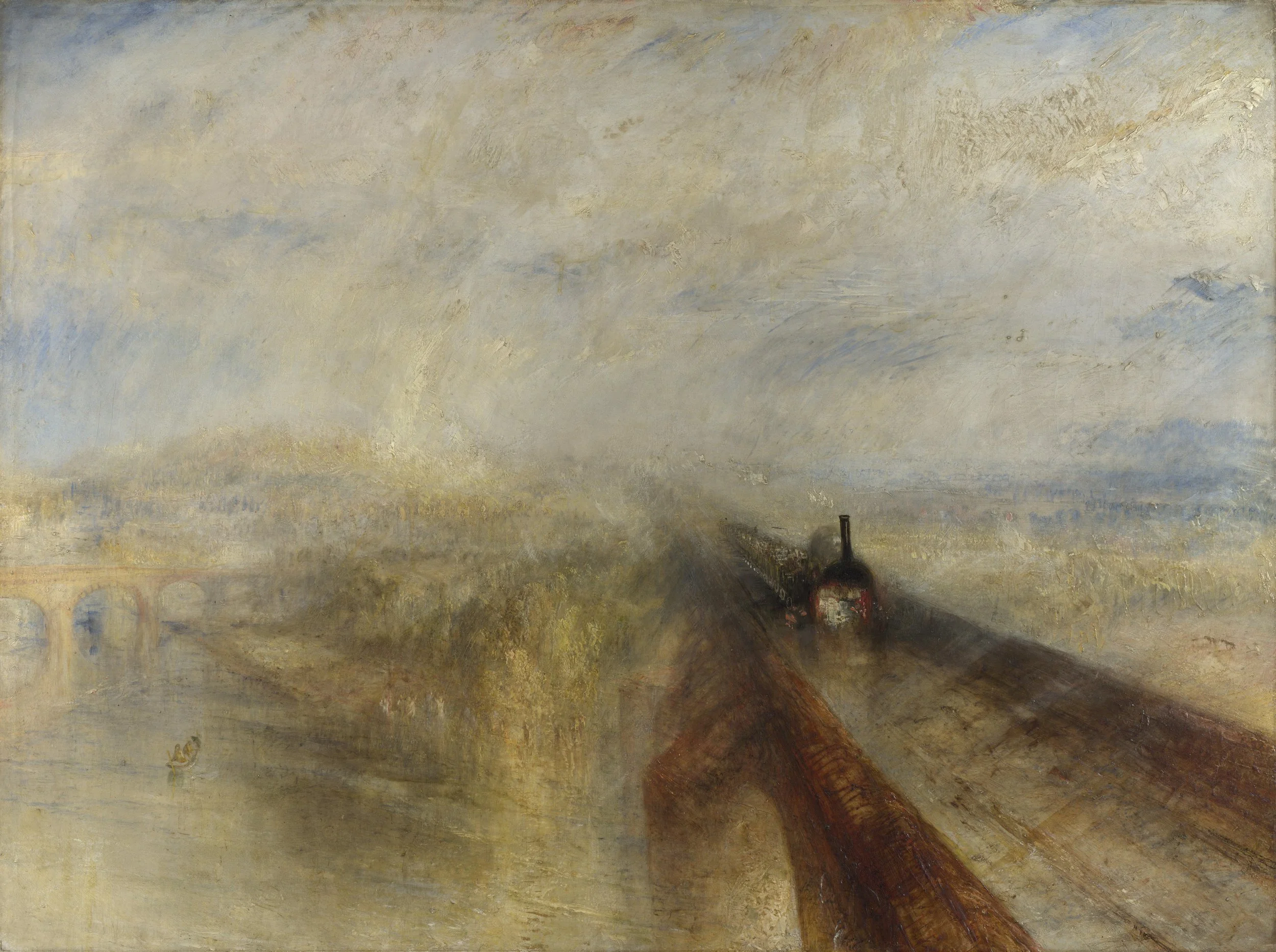
My ALL TIME FAVOURITE painting, Turner’s Rain, Steam and Speed, reminds me that life is rarely black and white. It is rain, light, steam, motion, fear, beauty, and becoming—all rushing toward what could be. Like Turner, I see the world not only as it is, but as it is still becoming. The train is coming, the future is moving, and grace is somewhere in the mist.
J. M. W. Turner’s Rain, Steam and Speed – The Great Western Railway is not merely a painting I admire; it is my ALL TIME FAVOURITE painting. It is one of those works that refuses to sit politely on the wall. It moves. It breathes. It rushes toward you like weather, machinery, prophecy, and caffeine all at once. Painted in 1844, it captured Victorian England at the edge of a new world, where the steam train became more than transportation; it became a symbol of industry, power, progress, and the unsettling thrill of change (National Gallery, n.d.). Turner did not simply paint a train. He painted the future arriving before everyone had agreed they were ready for it.
That is what makes Turner feel like Impressionism before Impressionism. Long before Monet and his misty stations, Turner was already dissolving the world into light, motion, atmosphere, and feeling. The Ashmolean Museum notes that Turner’s use of light, color, and atmosphere helped pave the way for the Impressionists (Ashmolean Museum, n.d.). His genius was not in painting every rivet, rail, or brick with obedient precision. His genius was in painting what it felt like to stand before the new age as it thundered toward you. Turner once declared, “Light is therefore colour,” a line from his Royal Academy lecture that perfectly captures his whole way of seeing (Bank of England, 2016). He did not see the world in black and white. He saw it in gold, grey, vapor, rain, shadow, fire, and possibility.
That is where I feel a deep kinship with Turner. Like him, I do not naturally see life as fixed, flat, or finished. I see it in terms of what is coming and what could be. I see the world as a million shades of beauty, even when some of those shades arrive wrapped in storm clouds. Turner’s train cuts through rain and steam, but it does not stop. It presses forward. That speaks to me. For Victorian England, the train represented industry, modernity, speed, and a transformed nation. For me, the train represents change, growth, recovery, becoming, and the strange grace of being carried into a future I did not fully plan but still dare to enter.
John Ruskin, Turner’s great defender, understood that Turner was not merely painting scenery. He was painting vision. Ruskin famously observed that Turner “paints in colour, but thinks in light and shade” (Jones, 2025). That is exactly the spiritual truth I find in this painting. Life is not one simple tone. It is not all sorrow or all triumph, all loss or all restoration. It is light and shade together. It is rain, steam, and speed. It is the bridge between what was and what is coming next.
Scripture gives language to that same movement. Isaiah records God’s promise: “See, I am doing a new thing!” (New International Version Bible, 2011, Isaiah 43:19). Turner’s train feels like that verse in motion. It is the new thing appearing through the mist. It is the future breaking through the rain. It is frightening, yes. But it is also beautiful. And perhaps that is the point. Growth rarely arrives looking tidy. Sometimes it comes roaring down the track, wrapped in steam, shaking the bridge beneath our feet, and daring us to believe that the journey is not over.
References
Ashmolean Museum. (n.d.). J. M. W. Turner: Reflections on the painter of light. https://www.ashmolean.org/article/reflections-on-the-painter-of-light
Bank of England. (2016). J. M. W. Turner to appear on the next £20 banknote. https://www.bankofengland.co.uk
Jones, J. (2025, February 7). Turner: In light and shade review – Bathe in the redemptive power of landscape art. The Guardian. https://www.theguardian.com
National Gallery. (n.d.). Joseph Mallord William Turner: Rain, Steam, and Speed – The Great Western Railway. https://www.nationalgallery.org.uk
New International Version Bible. (2011). Zondervan. Original work published 1978.y