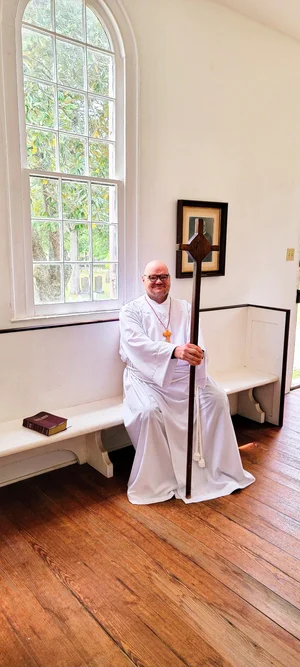
The Monastery in My Mind and the Gravity I Refuse to Obey
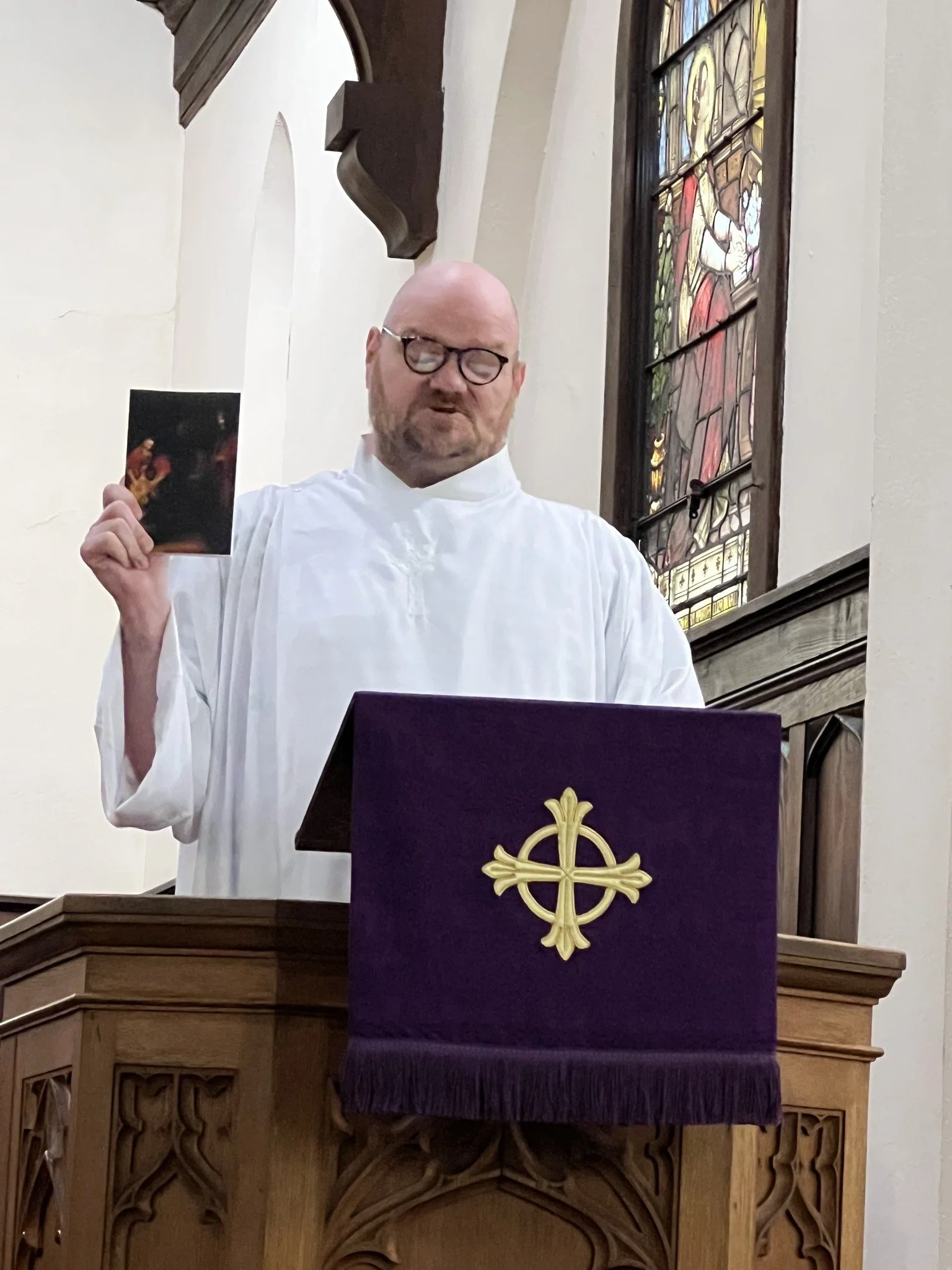
Delivering the homily — standing in that sacred space between study, prayer, humor, and hope. A reminder that the quiet cell of the soul is not an escape from service, but the place where service is strengthened.
Photo by Van Pate.
Yesterday, I turned 47, and I find myself thinking less about age and more about formation.
Not the loud kind. Not the kind with applause, a dramatic entrance, or a spotlight. I am thinking about the quieter kind of formation: the kind that happens in stillness, prayer, reading, waiting, and those long inward seasons when God seems to be doing His deepest work behind the locked doors of the soul.
Lately, I have realized something about myself.
I have a monkish mind.
Now, I am not saying I am ready to vanish into a monastery, take a vow of silence, and spend my days copying manuscripts by candlelight in a cold stone room. But let us be honest: some days that sounds less like deprivation and more like a luxury retreat with better architecture, fewer emails, and possibly better tea.
Give me a small cell, a stack of books, a candle, a chapel bell somewhere in the distance, and a window looking out over some moody landscape, and I would probably say, “Yes, this is manageable. Where do I sign?”
Of course, I love people. I love teaching. I love ministering. I love helping students, encouraging friends, explaining ideas, and walking beside people as they try to find their way through life. I know my calling is not simply inward. I am, at heart, a servant educator.
But after the conversations, the appointments, the worries, the medical updates, the teaching, the caregiving, and the general circus act of being a responsible adult in the modern world, I feel a deep pull to retreat.
Not to escape.
To return.
I want to go back to my room — my little cell, if we are being properly monastic and slightly Gothic — and become still. I want to read. I want to think. I want to pray. I want the noise of the world to fall away until something deeper rises in its place.
Many people are frightened by solitude. Silence unnerves them. Stillness feels like punishment. They need the television on, the phone in hand, the music playing, the notifications buzzing, and the world constantly proving that they are not alone.
But solitude has never felt like an enemy to me.
It feels like peace.
In the quiet, my mind and soul reconnect with something higher than myself. I do not feel empty there. I feel gathered. Less scattered. Less frantic. Less divided. In stillness, I remember who I am, whose I am, and what I am here to do.
Jesus said, “When you pray, go into your room, close the door and pray to your Father, who is unseen” (Matthew 6:6, New International Version, 2011). That verse has taken on a deeper meaning for me lately. I do not think it is only about shutting a physical door. I think it is also about entering a sacred interior room where the soul stops performing and finally becomes honest before God.
That is what this season has been teaching me.
The room is not just a room.
The silence is not just silence.
The stillness is not emptiness.
It is where God meets me.
Lately, I have been reading more philosophy and theology, and it has strengthened this feeling in me. Philosophy has helped me ask better questions. Theology has helped me sit more faithfully with the answers I do not yet have. Together, they have reminded me that the life of the mind and the life of the spirit were never meant to be enemies. Thought can become prayer. Reading can become devotion. Silence can become worship.
There is something sacred about developing an inner life.
The modern world does not always value that. Modern life rewards speed, noise, productivity, visibility, and constant availability. We are measured by what we produce, how quickly we respond, how visible we remain, and how well we can keep moving even when our souls are tired.
But the inner life moves by a different rhythm.
It listens.
It waits.
It notices.
It asks what God is doing beneath the surface.
Outwardly, I fit somewhat well into the modern world. I can handle the meetings, the emails, the deadlines, the passwords, the forms, the calendars, the notifications, and the sacred modern ritual of proving to a computer that I am not a robot.
But inwardly, I belong to something older and quieter.
Somewhere in my soul lives a Georgian British gentleman who was accidentally dropped into the twenty-first century and handed a smartphone, a medical chart, a wheelchair, and an Apple calendar. He is doing his best. He would prefer a chapel, a library, a strong cup of tea, and fewer updates from the pharmacy.
That inward part of me matters.
It is where I am renewed. It is where I gather strength. It is where I can return to others with more patience, more wisdom, more compassion, and hopefully fewer dramatic sighs.
This inner life has carried me through some of the hardest seasons I have ever faced.
It carried me through an amputation.
It carried me through a doctoral program.
It is carrying me now as I continue healing and holding on to hope.
And one of the strangest gifts God has given me through all of this is humor.
Not shallow humor. Not denial. Not pretending everything is fine when the medical chart is clearly auditioning for a Gothic novel. I mean the kind of humor that rises up in the middle of pain and says, “You may hurt me, but you do not get to define me.”
Humor helps me breathe. It helps me survive the absurdity of suffering. It lets me tell the truth without drowning in it. It helps me look fear in the face, raise one eyebrow, and say, “Well, this is deeply inconvenient.”
Laughter does not mean the pain is small.
It means the pain does not get the final word.
There is grace in that.
There is also sarcasm, and I believe the Lord knew exactly what He was doing when He gave me both.
This is why Defying Gravity from Wicked has been on my mind. I am not currently flying over Oz in a black cape with a broom and a full orchestra behind me, the spirit of that song speaks to something deep in me right now.
It is about reaching the moment when you stop apologizing for becoming who you were meant to be. It is about refusing to shrink because other people are more comfortable when you stay small. It is about letting go of the rules, fears, judgments, and limits that have kept you pinned to the ground. It is about finally deciding that what tried to hold you down does not get to own you.
That is where I feel myself standing.
Not fully healed.
Not fully fearless.
Not fully finished.
But no longer willing to let fear be the loudest voice.
There are many kinds of gravity in life. Illness has gravity. Grief has gravity. Exhaustion has gravity. Medical uncertainty has gravity. Other people’s expectations have gravity. The past has gravity. Fear has gravity. Even our own self-doubt can pull us downward until we begin to believe that staying low is the safest thing we can do.
But faith gives the soul another direction.
Hope gives the spirit lift.
Prayer reminds me that I am not held only by what pulls me down. I am also held by the God who calls me upward.
So perhaps I am learning, in my own way, to defy gravity.
Not by denying pain.
Not by pretending fear is not real.
Not by acting as if healing is easy.
But by refusing to let suffering write the whole story.
This season has slowed me down. It has humbled me. It has made me listen. It has forced me to stop confusing movement with purpose.
Stillness can feel like interruption.
Illness can feel like exile.
Recovery can feel like waiting in a room where no one remembered to install a clock.
But I am beginning to see that this season is not wasted. God is not absent from it. I am not being discarded. I am being formed in a hidden way.
I have made many plans for my life. Detailed plans. Responsible plans. Plans with headings, subheadings, timelines, measurable outcomes, and probably a properly formatted reference list. But Proverbs reminds us, “In their hearts humans plan their course, but the Lord establishes their steps” (Proverbs 16:9, New International Version, 2011).
That verse feels especially personal right now.
I have planned many courses.
God is still establishing my steps.
Even now.
Even here.
Even in this season.
At 47, I am not exactly where I expected to be, but I am not without purpose. I believe my life is still meant to serve others. I believe I am called to teach, encourage, minister, write, and help people find hope, education, dignity, and access.
And I believe God has more plans for me.
This current season is not the end of the story. It is a chapter. A difficult chapter, yes. A quiet chapter. A chapter with far more medical appointments than I would have selected for character development. But still only a chapter. It will pass.
And when it does, I believe I will emerge with a deeper spirit, a steadier mind, a clearer calling, a sharper sense of humor, and a stronger understanding of why I am still here.
Maybe that is what this season has been about.
I am learning to see my room as a kind of cell, but not a prison cell. A monk’s cell. A place of study. A place of prayer. A place where the soul learns to breathe. A place where God whispers what the world is too loud to hear.
So today, at 47, I am grateful.
Grateful that God is still working, even when I cannot see the full design.
I am in a season now, but seasons change.
This one will pass.
And I believe, with all my heart, that I am moving toward the best season of my life.
Until then, I will keep reading.
I will keep praying.
I will keep listening.
I will keep healing.
I will keep laughing.
I will keep serving.
And when the gravity of this life tries to pull me down, I will keep choosing faith, hope, humor, and the holy audacity to rise anyway.
Or it could all be the Ativan talking.
References
Holzman, W., & Schwartz, S. (2003). Defying Gravity [Song]. On Wicked: Original Broadway Cast Recording. Decca Broadway.
New International Version Bible. (2011). Zondervan. https://www.thenivbible.com/