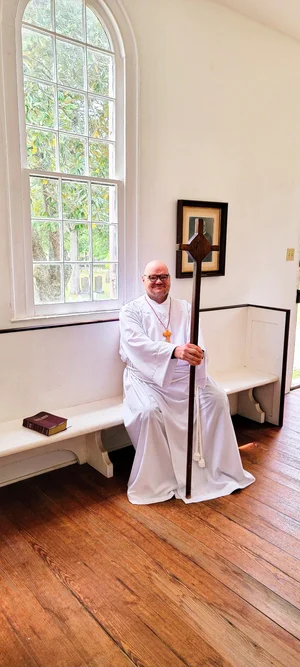
Downtown in the Oxygen Tube: Fear, Faith, and Healing Under Pressure
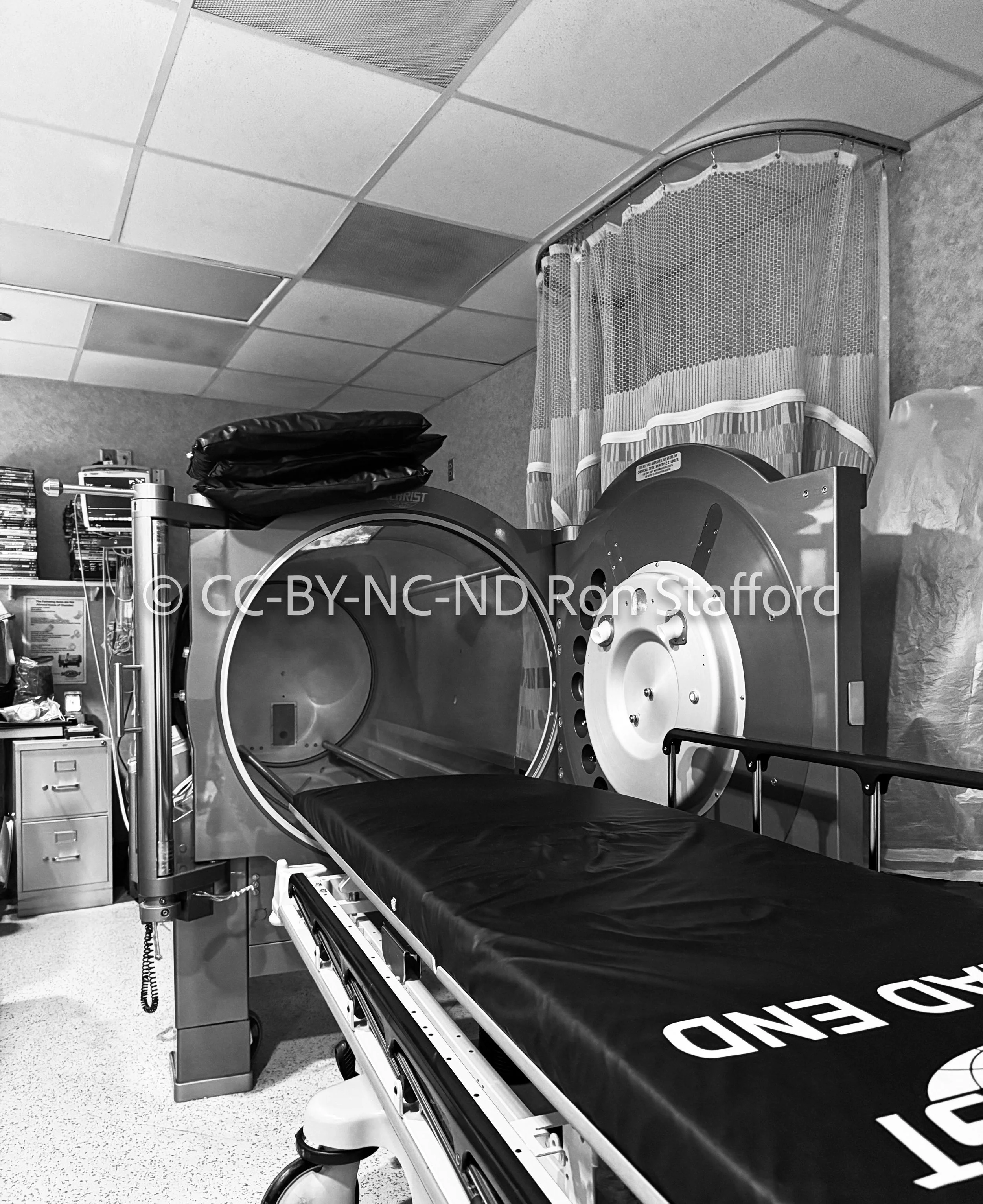
The chamber I feared became the place I found peace. Today’s view: metal, acrylic, oxygen, prayer, and the strange grace of discovering I can do hard things.
Photo by Ron Stafford.
Today I did something I had been quietly dreading.
I began Hyperbaric Oxygen Therapy for my foot ulcer, which sounds very medical and sensible until you are the one being asked to slide your body into a long chamber with metal ends, acrylic sides, and a clear acrylic top that closes over you like something between a science-fiction sleep pod, a submarine, and a very expensive Tupperware container for anxious academics.
From the outside, it looked terrifying.
I had imagined panic. I had imagined being trapped. I had imagined every anxious thought I own gathering in my head for a full faculty senate meeting, complete with handouts, subcommittees, and one person who keeps saying, “I have more of a comment than a question.”
And to be fair, my imagination is not exactly restrained. My mind does not do “mild concern.” My mind does fog machine, opera lighting, dramatic strings, and a tragic Italian tenor in the corner singing as though I have just been sealed inside the tomb of the House of Atreus.
But then something strange happened.
Once I was inside the chamber, it was not what I feared.
The tube became still. The clear walls made everything visible but slightly distant, as if the real world had been moved behind glass. Nurses passed by outside. Machines hummed. Voices softened. The air felt different. Pressurized. Heavy, but not threatening. I was in the room, but also not fully in the room. I was in one world and not quite of the real world.
It was surreal.
Not bad. Not unbearable. Just strange.
For a while, I felt like I had been placed inside a tiny transparent chapel of oxygen, pressure, prayer, acrylic, and reluctant personal growth. I had dreaded the closing of the door, but when it closed, I did not feel abandoned.
I felt held.
Now, was that God? Yes.
Was that Ativan? Also yes.
And I am not above admitting that sometimes grace arrives through prayer, trained medical professionals, and a small prescribed tablet taken at exactly the correct time. The Lord works in mysterious ways, and occasionally those ways are pharmaceutical.
Before I went in, I prayed. It was not a polished prayer. It was not one of those stained-glass prayers with thee, thou, and a pipe organ humming in the background. It was the kind of prayer you pray when your body has been through too much and your courage feels like it is being held together with Scotch tape.
“Lord, please help me do this.”
And He did.
Psalm 46:10 says, “Be still, and know that I am God” (New Revised Standard Version Updated Edition, 2021, Psalm 46:10). I have heard that verse my whole life, but today it became oddly literal. I had to be still. No fixing. No arranging. No overthinking. No trying to manage every possible outcome like I was chairing a strategic planning committee for my own nervous system.
Just stillness.
Just breath.
Just oxygen.
Just trust.
Isaiah 41:10 says, “Do not fear, for I am with you” (New Revised Standard Version Updated Edition, 2021, Isaiah 41:10). That verse is easy to put on a bookmark and much harder to believe when you are sliding into a sealed chamber to help save your foot. But today I understood it differently. God did not remove the tube. God met me inside it.
That may be the real lesson.
We often think courage means the scary thing disappears. But sometimes courage means the scary thing remains, the door closes, and somehow we discover that we are still breathing. Still safe. Still ourselves. Still held.
I thought I could not handle it.
Then I did.
And not only did I handle it, I did better than I expected. I settled. I breathed. I listened. I watched the world blur slightly beyond the chamber walls. I let the treatment do its work. What I had built up in my mind as unbearable became manageable. What I had feared became almost peaceful.
Perspective is a strange thing.
From the outside, the chamber looked like confinement.
From the inside, it became shelter.
And because my brain is apparently part theologian, part film studies professor, part jukebox, and part chaotic Georgian ghost, I kept thinking about Girl, Interrupted. In Susanna Kaysen’s memoir, she describes the unsettling experience of being both inside and outside ordinary life, observed by others while also observing herself, caught in a medical world that feels separate from the everyday world everyone else inhabits (Kaysen, 1993). That feeling stayed with me.
Inside that hyperbaric chamber, I felt slightly removed from everything. My body was there, healing under pressure. My mind was floating elsewhere. I was the patient, but also the observer of the patient. I was the man in the tube, but also the man thinking, “Well, this is certainly one of the weirder chapters.”
And then my mind went directly to the film version of Girl, Interrupted, specifically the “Downtown” scene. In the 1999 film, Susanna and the others try to calm Polly by singing Petula Clark’s “Downtown,” and what begins as one person trying to soothe another becomes a strange, tender, communal moment on the ward (Mangold, 1999). The scene is funny, sad, chaotic, and deeply human all at once — which, frankly, is also a fair summary of my entire medical journey.
So, naturally, when the chamber door closed, my mind heard Petula Clark.
Not a hymn.
Not Gregorian chant.
Not Bach.
Petula Clark.
There I was, sealed inside a glowing medical tube, looking like I had been prepared for launch by NASA’s Department of Wound Care, and my brain decided the correct soundtrack was “Downtown” (Clark, 1964). Honestly, I respect the choice.
There was something oddly perfect about it. In Girl, Interrupted, the song becomes a way of pulling Polly back from fear. It does not solve everything. It does not erase pain. But it gives the moment somewhere to go. It gives fear a rhythm. It gives distress a little absurdity, a little tenderness, a little light.
That is what I felt in the chamber.
The fear did not vanish instantly. But it softened. It became smaller. It became something I could sit with. Something I could breathe through. Something that no longer ruled the room.
Or the tube.
Or me.
Maybe healing is like that. It is not always solemn. Sometimes it is strange. Sometimes it is funny. Sometimes it is holy and ridiculous at the same time. Sometimes God steadies your spirit while Petula Clark provides the soundtrack and Ativan quietly sits in the corner like a very calm deacon.
History is full of people who entered frightening, confined, or impossible spaces and came out transformed. I thought about Nelson Mandela, who spent twenty-seven years imprisoned, much of that time on Robben Island, and yet emerged not as a small man crushed by confinement, but as someone whose endurance had been sharpened by suffering (Mandela, 1994). I am certainly not comparing my hyperbaric chamber to Robben Island. My little acrylic tube came with oxygen, medical staff, and a panic button. But the spiritual principle still speaks sometimes the place we fear entering becomes the place where something in us is strengthened.
Sometimes the door we dread closing is not the door to disaster.
Sometimes it is the door into healing.
Today I learned that I am still more resilient than fear tells me I am. I learned that my imagination can turn a medical treatment into a Gothic novella, but reality can be gentler than the story I wrote in my head. I learned that pressure is not always punishment. Sometimes pressure is treatment. Sometimes pressure is what allows oxygen to reach the places that need life again.
And maybe that is true beyond the body.
Maybe the soul, too, sometimes heals under pressure.
I am thankful today. Thankful for the doctors and nurses. Thankful for the chamber I dreaded. Thankful for oxygen doing its quiet work. Thankful for prayer. Thankful for medicine. Thankful for the strange mercy of realizing that the thing I feared was not as bad as I imagined.
I went into the tube afraid.
I came out reminded.
The God I trusted was faithful. The treatment I dreaded was manageable. My anxious brain was dramatic, but not prophetic. And somewhere in that surreal little world of acrylic, metal, oxygen, pressure, prayer, and Petula Clark, I found peace.
Psalm 147:3 says, “He heals the brokenhearted, and binds up their wounds” (New Revised Standard Version Updated Edition, 2021, Psalm 147:3).
Today, I believe that with my whole foot, my whole heart, and my whole strange, healing, still-singing soul.
References
Clark, P. (1964). Downtown [Song]. On Downtown. Pye Records.
Kaysen, S. (1993). Girl, interrupted. Turtle Bay Books.
Mangold, J. (Director). (1999). Girl, interrupted [Film]. Columbia Pictures.
Movieclips. (2011, May 26). Girl, Interrupted (1999) - Downtown scene (5/10) | Movieclips [Video]. YouTube. https://youtu.be/F58XJgGx3DY
Mandela, N. (1994). Long walk to freedom: The autobiography of Nelson Mandela. Little, Brown and Company.
New Revised Standard Version Updated Edition. (2021). National Council of Churches. https://www.ncccusa.org/new-revised-standard-version-updated-edition-nrsvue/