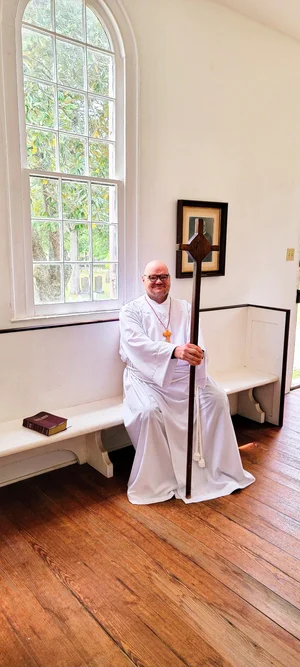
Glass remembers the fire. So do I.
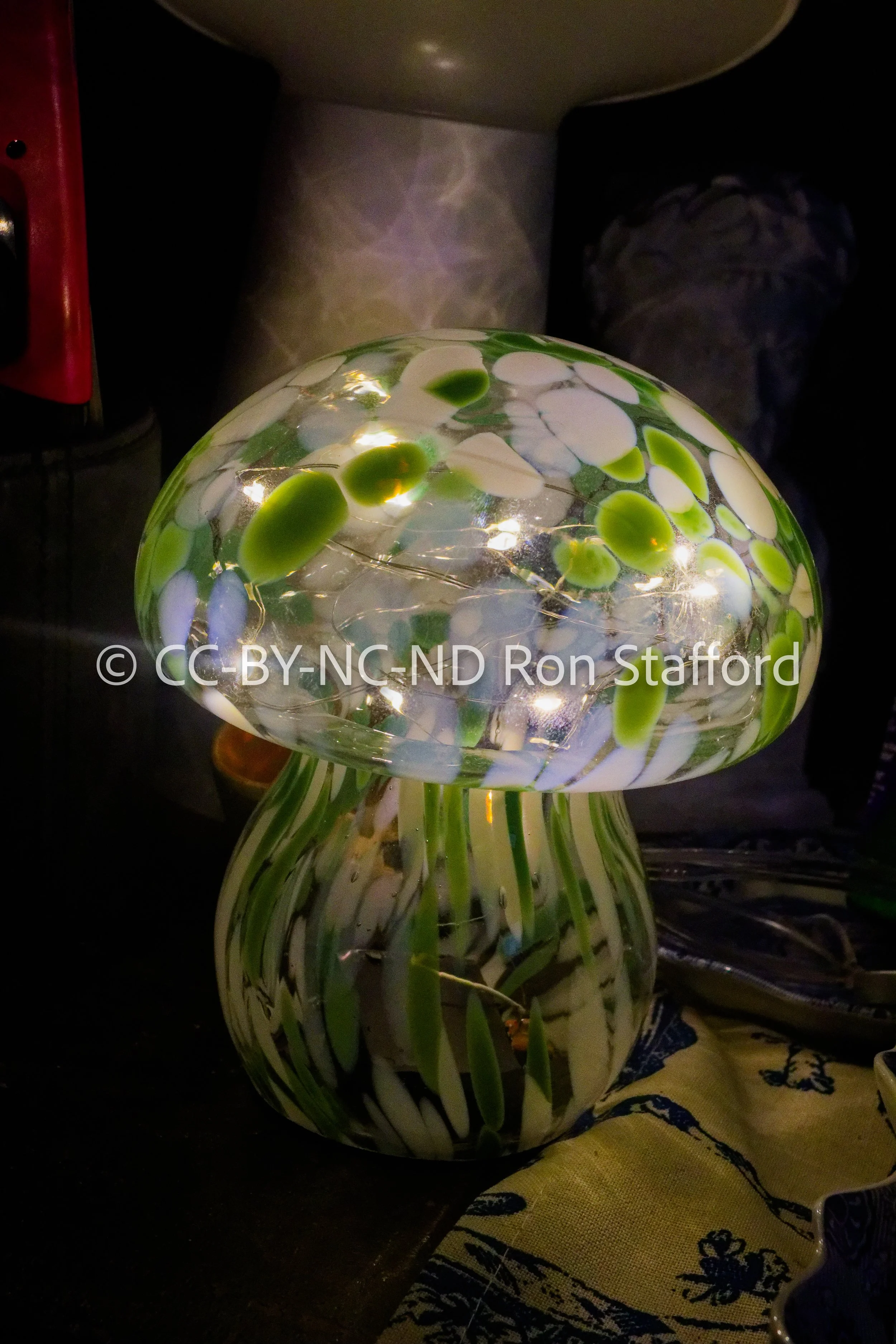
I took this photo of glass remembering the fire, while still learning how to hold the light.
Remolded, re-fired, and still becoming.
I have always loved glass because it begins as something humble and almost absurdly ordinary: sand, minerals, heat, breath, and the steady hand of someone who knows how to coax beauty from danger. There is something wonderfully theological about that. Before glass becomes luminous, it must first become molten. Before it becomes art, it must surrender its old form. Before it catches the light, it has to survive the furnace.
This little glass mushroom in my photograph feels whimsical at first glance, almost as if it wandered out of a fairy tale, sat itself down on my table, and decided to glow. But the more I look at it, the more serious it becomes. It is playful, yes, but it is also a small sermon in green, white, blue, and light. Venetian and Murano glassmaking traditions transformed raw material into luxury, color, delicacy, and wonder through heat, breath, molding, and handwork (Corning Museum of Glass, n.d.). It is fragile, but not weak. It is ornamental, but not empty. It is beautiful precisely because it has endured shaping.
That is what I see here: not just glass, but becoming.
Like glass, I was formed. I was shaped by family, place, faith, books, classrooms, churches, archives, old buildings, art, and all the strange southern landscapes that made me who I am. Then life did what life sometimes does. It placed me back into the furnace. Illness, amputation, pain, fear, grief, uncertainty, and spiritual exhaustion did not simply inconvenience me. They deformed me. Physically, yes, but also spiritually. There were days when I did not feel like a vessel being refined. I felt like a thing dropped, cracked, and swept to the edge of the table.
And yet, annoyingly, beautifully, inconveniently, God was not finished.
That is the part I keep returning to. We often want resurrection without the tomb, transformation without the furnace, Paradise without ever admitting we are lost in the dark wood. Dante knew better. The Divine Comedy begins not in triumph, but in bewilderment: a soul finding itself “midway” through life and lost in a shadowed place (Dante, trans. 2003). That has become more than literature for me. It has become a map. Dante’s journey moves downward before it moves upward. He must pass through terror, judgment, memory, purification, and longing before he can bear the sight of divine light. That feels true. Sometimes the way back to God is not a straight, polished marble staircase. Sometimes it is a dark road, a wounded body, a medical chart, a waiting room, a prayer whispered through clenched teeth, and the uncomfortable suspicion that grace may be working even here.
Karen Nilsen’s (my old and dear friend) The Witch Awakening, the first book in The Landers Saga, gives me another way to think about this strange, painful business of transformation. Safire of Long Marsh lives in a world where hidden gifts are dangerous, where fire is not merely symbolic, and where becoming fully herself carries real risk. At one point, Safire says, “It must be well nigh impossible, to be forced to believe in something after believing in nothing for so long” (Nilsen, 2010, as excerpted by Barnes & Noble). That sentence stops me because healing often feels exactly like that. It forces belief upon us when belief has grown thin. It asks us to trust again after the body has failed, after the spirit has gone quiet, after the old self has cracked under pressure. And, in typical fashion, life does not send a polite engraved invitation. It simply drags us into the furnace and says, “Now, let us see what can still be made.”
Virginia Woolf, in a very different key, also understood that life is made of fragile illuminations. Her writing often pauses over the small, shimmering moments when the ordinary suddenly becomes charged with meaning, when a flower, a room, a sentence, a sound, or a passing image opens into the deep interior life (Woolf, 1925, 1927). Woolf reminds me that the soul does not always announce itself with trumpets. Sometimes it flickers. Sometimes it glows quietly inside the ordinary. Sometimes it sits on a shelf in the shape of a glass mushroom, looking slightly ridiculous and utterly profound.
And perhaps that is why this photograph speaks to me. Glass is both surface and depth. You can see it, but you can also see through it. It reflects light, but it also holds light. It is formed by pressure, yet still capable of beauty. That feels like the life I am trying to understand now. I am not who I was before all this happened. I cannot pretend otherwise. My body has changed. My spirit has been tested. My plans have been interrupted with the subtlety of an opera finale. But maybe the point was never to return unchanged. Maybe the point was to be remade.
Scripture says, “So if anyone is in Christ, there is a new creation: everything old has passed away; look, new things have come into being!” (2 Corinthians 5:17, NRSV). I used to hear that verse as a clean, bright promise. Now I hear it as something deeper and harder. New creation does not mean the old wounds vanish. It means they no longer possess the authority to name us. The scar remains, but it is no longer only a record of injury. It becomes a witness. It says: I was broken but not abandoned. I was altered but not erased. I passed through fire, and still, by grace, I caught the light.
That is where the phoenix enters the picture, slightly dramatic and probably overdressed, as all good mythic creatures should be. The phoenix rises from ash, not because the fire was harmless, but because the fire was not final. That is the distinction. Pain is real. Loss is real. Deformation is real. But they are not ultimate. In Christian language, resurrection has the final word. In Dante’s language, the journey bends toward the stars. In Woolf’s language, the moment still shines. In Nilsen’s world, belief can return even after disbelief has had a long and stubborn reign (Nilsen, 2010). In the glassmaker’s language, the material can be gathered again, heated again, shaped again, and made luminous again.
So this photograph is not just a charming little object. It is a theological mushroom, which is a phrase I did not expect to write, but here we are. It is a reminder that beauty is not always born from ease. Sometimes beauty comes from heat, pressure, waiting, and skilled hands. Sometimes the thing we thought was deformation becomes the beginning of a new form.
Like glass, I have been in the furnace.
Like Dante, I have found myself in the dark wood.
Like Woolf, I am learning to notice the fragile light still trembling in ordinary things.
Like Safire in Nilsen’s The Witch Awakening, I am learning how strange and difficult it can be to believe again after a long season of nothingness.
And like the phoenix, I am rising, not untouched, not unscarred, not the same creature I was before, but remolded, re-fired, and, by the grace of God, still luminous.
APA 7 References
Bible Gateway. (n.d.). 2 Corinthians 5:17, New Revised Standard Version Updated Edition. Retrieved May 26, 2026, from https://www.biblegateway.com/
Corning Museum of Glass. (n.d.). The rise of Venetian glassmaking. https://whatson.cmog.org/exhibitions-galleries/rise-venetian-glassmaking
Dante Alighieri. (2003). The divine comedy (J. Ciardi, Trans.). New American Library. Original work published ca. 1321.
Nilsen, K. (2010). The witch awakening (The Landers Saga, Book 1). Self-published. Excerpt available from Barnes & Noble. https://www.barnesandnoble.com/w/the-witch-awakening-karen-nilsen/1100381080
Woolf, V. (1925). Mrs. Dalloway. Hogarth Press.
Woolf, V. (1927). To the lighthouse. Hogarth Press.