Faith, Place, and the Religious Imagination of South Carolina
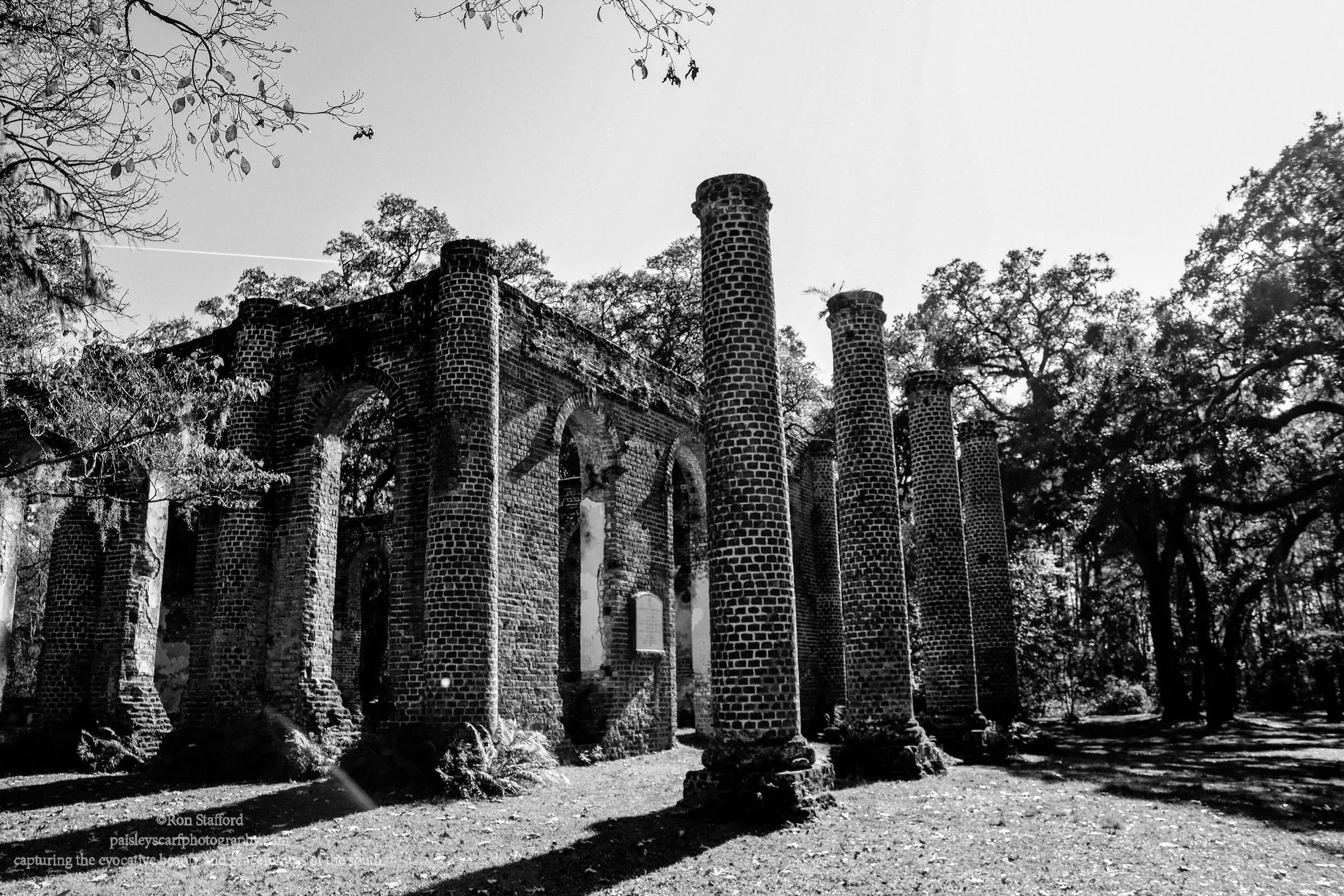
Old Sheldon Church Ruins, near Beaufort, South Carolina
There are some ruins that do not feel empty. Old Sheldon Church is one of them.
Originally known as Prince William’s Parish Church, Sheldon was built between 1745 and 1753 in what historians describe as one of the earliest American attempts to imitate the form of a classical Greek temple. Set among live oaks and old graves, the remaining brick walls and columns still carry the authority of the colonial Anglican world that shaped so much of early South Carolina religious life.
The church was burned by British troops in 1779 during the Revolutionary War, rebuilt in 1826, and later damaged again during the Civil War. The old tablet at the site records that it was burned by Federal forces in 1865, though later scholarship notes some debate about whether the church was fully burned or stripped for materials after the war.
That tension is part of what makes this place so powerful. Sheldon is not simply picturesque. It is a sacred ruin—colonial, Anglican, Southern, wounded, and still standing. In the broken arches and roofless nave, you can see how faith, empire, war, memory, and beauty all meet in the South Carolina Lowcountry.
Photograph by Ron Stafford.
To understand South Carolina, one must understand religion—not simply as doctrine or denomination, but as landscape, memory, power, survival, and place.
For me, that story begins at Old St. David’s in Cheraw. St. David’s is my home church, but it is also much more than a beloved local landmark. It is one of those rare places where personal memory and public history meet. Established in 1768 by the South Carolina General Assembly, St. David’s Parish was created in the final years of British colonial rule. The historic church was begun around 1770 and completed in 1774, just before the American Revolution transformed the political and religious order of the colonies. It is remembered as the last Anglican church in South Carolina built under the rule of King George III and the last parish established in the colony under British authority (Discover South Carolina, n.d.; South Carolina Picture Project, n.d.).
That fact has always stayed with me.
When I stand at Old St. David’s, I am not just looking at an old church. I am looking at the final architectural expression of an imperial religious order in South Carolina. The building belongs to the Church of England, to the British Crown, to the colonial parish system, and to the early religious imagination of the Carolina backcountry. But it also belongs to the Revolution, to local memory, to Episcopal identity, and to the generations of people who have worshipped, mourned, married, prayed, and been buried there.
In that sense, Old St. David’s is not only a sacred space. It is a historical argument.
The colonial religious story of South Carolina begins most formally with the Church of England. In 1706, the South Carolina Church Act established the Church of England as the official church of the colony. The act divided the province into parishes and required public support for Anglican churches, clergy, cemeteries, parsonages, and glebe lands. The parish was not simply a religious unit. It was also a civic structure. In colonial South Carolina, the parish helped organize worship, taxation, poor relief, public records, local identity, and political authority (College of Charleston Lowcountry Digital History Initiative, n.d.; Edgar, 2016).
That structure matters because it reminds us that religion in colonial South Carolina was never merely private. It was public, institutional, and deeply connected to power. The Church of England carried the authority of the Crown, the Book of Common Prayer, the parish vestry, and the social hierarchy of the colony. To be Anglican in colonial South Carolina was not only to belong to a church. It was, in many cases, to stand near the center of colonial respectability and civic legitimacy.
And yet South Carolina was never religiously simple.
Even with the Church of England established by law, the colony was always more religiously diverse than the official system suggested. Charleston and the wider colony included Anglicans, French Huguenots, Sephardic Jews, Presbyterians, Congregationalists, Baptists, Quakers, Lutherans, Catholics, and others. The story of South Carolina religion is therefore not only the story of establishment. It is also the story of dissent, migration, exile, adaptation, and survival.
The Huguenots are one of the clearest examples. French Protestants came to South Carolina after fleeing persecution in Catholic France, especially after the revocation of the Edict of Nantes in 1685. Their presence in Charleston and the Lowcountry reminds us that religious identity was often bound to displacement. The Huguenots came seeking refuge, but they also became part of the cultural, economic, and religious development of colonial South Carolina. Over time, many Huguenot families assimilated into Anglican society, while others preserved a distinct French Protestant memory that remains visible in Charleston today (French Protestant Church, n.d.).
The Jewish community of Charleston also occupies an essential place in this history. Kahal Kadosh Beth Elohim was founded in 1749 and became one of the oldest Jewish congregations in what is now the United States. Its history complicates any narrow understanding of colonial South Carolina as simply Anglican or Protestant. Jewish Charlestonians contributed to the religious, commercial, civic, and intellectual life of the city. Later, the congregation would become central to the emergence of Reform Judaism in America, but its colonial roots remind us that Jewish life in South Carolina was present from an early period and deserves to be understood as part of the state’s foundational religious landscape (Kahal Kadosh Beth Elohim, n.d.; Jewish Historical Society of South Carolina, n.d.).
Presbyterians and Congregationalists also shaped the colony, especially through the dissenting tradition. Circular Congregational Church in Charleston traces its origins to 1681 and emerged from a community that included English Congregationalists, Scots Presbyterians, and French Huguenots. The very name “Meeting Street” reflects the dissenting meetinghouse tradition. That detail has always struck me because it shows how religious dissent was not only theological; it became geographic. It marked the city itself (Circular Congregational Church, n.d.).
The Presbyterians were especially important in the backcountry and among Scots-Irish settlers. Their tradition brought with it a serious intellectual culture—rooted in preaching, literacy, covenant theology, education, and moral discipline. In many ways, Presbyterianism helped shape the religious and educational character of the Carolina interior. It was less tied to the formal Anglican establishment of Charleston and more connected to migration, settlement, family networks, and local resilience.
Catholics occupied a more precarious position. Colonial South Carolina’s language of religious toleration often had limits, and those limits were especially clear in the treatment of Catholics. Anti-Catholic suspicion, inherited from English Protestant fears of France, Spain, and Rome, shaped the colony’s religious boundaries. In other words, colonial toleration did not mean modern religious liberty. Some groups were welcomed more readily than others. Some were tolerated because they were useful to settlement and commerce. Others were treated with suspicion because they challenged the Protestant and imperial assumptions of the colony.
Charles Woodmason helps us see these tensions more clearly.
Woodmason was an Anglican itinerant minister who traveled through the Carolina backcountry in the 1760s. His journal is one of the most important surviving primary sources for understanding religion, class, poverty, settlement, and social conflict in the colonial interior. He was not neutral. He was often impatient, elitist, and deeply frustrated by what he saw as disorder in the backcountry. But that is precisely what makes his writing so revealing. Woodmason gives us the voice of the Anglican establishment trying to make sense of a world that was slipping beyond its control (Hooker, 1953; Moore, 2016).
In his journal, Woodmason repeatedly described the backcountry as spiritually neglected and socially unstable. He worried about the lack of Anglican churches, schools, clergy, and proper religious instruction. He complained about the influence of “New Lights” and dissenting preachers, especially Baptists and Presbyterians, whose emotional and evangelical styles challenged the authority of the Church of England (Hooker, 1953). To Woodmason, this was evidence of disorder. To a modern reader, it can also be read as evidence of religious energy.
That distinction matters.
The backcountry was not simply irreligious because it was not Anglican. It was religious in ways that did not always fit the expectations of Charleston, London, or the colonial establishment. People gathered in homes, fields, rough meetinghouses, and frontier settlements. They heard Baptist, Presbyterian, Methodist, and other evangelical voices. They built religious communities out of scarcity. They did not always have polished churches, trained clergy, or formal parish structures, but they had hunger—for meaning, for order, for grace, for belonging.
That is one of the things I find most compelling about South Carolina’s religious history. Faith here was never only handed down from institutions. It was also improvised by people trying to survive.
Of course, no honest discussion of South Carolina religion can ignore slavery. The colonial church existed within a society built on enslaved labor. Anglican parishes, dissenting congregations, plantation chapels, and later evangelical movements all developed within a world marked by bondage. Enslaved Africans and African Americans encountered Christianity under conditions of coercion, surveillance, and profound injustice. Yet they also reshaped Christian faith into a language of endurance, hope, resistance, and liberation. Over time, Black religious life became one of the most powerful intellectual and spiritual traditions in South Carolina.
That contradiction must be held honestly. The same religious culture that preached salvation often lived comfortably beside slavery. The same sacred landscapes that inspire reverence also carry grief. South Carolina’s churches are beautiful, but they are not innocent. They are part of a history that asks us to look carefully, not sentimentally.
By the time of the American Revolution, the old Anglican order was already weakening. The Revolution did more than separate the colonies from Britain. It also disrupted the established church. The Church of England, once supported by colonial law and public funds, could no longer occupy the same position after independence. In South Carolina, as elsewhere, Anglican identity gradually became Episcopal identity, and the parish system lost much of its former civic authority (Edgar, 2016).
That is why Old St. David’s matters so much to me. It stands at the hinge of that transformation. It was built under the Crown, but it survived the Revolution. It was born into Anglican establishment, but it became part of American Episcopal life. It was used during the Revolutionary War and later during the Civil War, carrying the marks of conflict, memory, and continuity (Discover South Carolina, n.d.; South Carolina Picture Project, n.d.).
In many ways, Old St. David’s represents South Carolina itself: colonial and American, sacred and political, beautiful and complicated, wounded and enduring.
As South Carolina moved into the nineteenth and twentieth centuries, its religious landscape continued to change. Baptist, Methodist, Presbyterian, Pentecostal, holiness, and other evangelical traditions grew across the state. African American churches became centers of worship, education, mutual aid, political organizing, and cultural memory. Catholic communities expanded. Jewish congregations continued to shape civic and religious life. More recent decades have brought increased religious diversity, including Muslim, Hindu, Buddhist, Orthodox Christian, and other communities.
Still, I believe the colonial period remains essential because it established many of the patterns that continue to shape South Carolina’s religious imagination: establishment and dissent, hierarchy and survival, tradition and improvisation, beauty and contradiction.
That is also why this history feels personal to me. My own intellectual life has always been rooted in place. I do not approach religion as something abstract or detached. I understand it through old churches, cemeteries, archives, parish records, family memory, architecture, and landscape. I understand it through the doorways of St. David’s, the churchyards of Charleston, the meetinghouses of dissenters, the prayers of exiles, and the sacred spaces built by people who were trying to make meaning in a difficult world.
That, to me, is part of the Southern intellectual tradition.
It is not merely about being well read or historically informed. It is about knowing that ideas live somewhere. Faith lives somewhere. Memory lives somewhere. In South Carolina, religion lives in brick churches, tabby ruins, grave markers, baptismal fonts, old roads, parish lines, family names, and stories we are still trying to tell truthfully.
So when I return to Old St. David’s, I return not only as a person of faith, but as a historian, a Southerner, an educator, and someone still learning how to listen to place.
South Carolina’s religious history is not one clean story.
It is the Church of England and the Crown.
It is St. David’s Parish at the edge of revolution.
It is Huguenot exile and Jewish endurance.
It is Presbyterian discipline and Congregational dissent.
It is Catholic exclusion and later belonging.
It is Baptist fire in the backcountry.
It is enslaved people making hope in a world that denied their freedom.
It is Woodmason’s anxious Anglican eye watching the frontier change before him.
It is Charleston and Cheraw, Lowcountry and backcountry, establishment and survival.
And it is still speaking.
The work is to listen carefully.
References
Circular Congregational Church. (n.d.). A brief history of the Circular Church. https://www.circularchurch.org/history
College of Charleston Lowcountry Digital History Initiative. (n.d.). The landscape of religion. https://ldhi.library.cofc.edu/exhibits/show/stono-preserves-landscape/landscape-of-religion
Discover South Carolina. (n.d.). Hallowed ground: Old St. David’s Church in Cheraw. https://discoversouthcarolina.com/articles/hallowed-ground-old-st-davids-church-in-cheraw
Edgar, W. B. (2016). Church Act. South Carolina Encyclopedia. https://www.scencyclopedia.org/sce/entries/church-act/
French Protestant Church. (n.d.). History of the Huguenot Church. https://www.huguenot-church.org/history.html
Hooker, R. J. (Ed.). (1953). The Carolina backcountry on the eve of the Revolution: The journal and other writings of Charles Woodmason, Anglican itinerant. University of North Carolina Press.
Jewish Historical Society of South Carolina. (n.d.). History of Kahal Kadosh Beth Elohim. https://jhssc.org/history-of-kahal-kadosh-beth-elohim-kkbe/
Kahal Kadosh Beth Elohim. (n.d.). History. https://www.kkbe.org/history/
Moore, A. (2016). Woodmason, Charles. South Carolina Encyclopedia. https://www.scencyclopedia.org/sce/entries/woodmason-charles/
South Carolina Picture Project. (n.d.). Old St. David’s Episcopal Church. https://www.scpictureproject.org/chesterfield-county/old-st-davids-episcopal-church.html
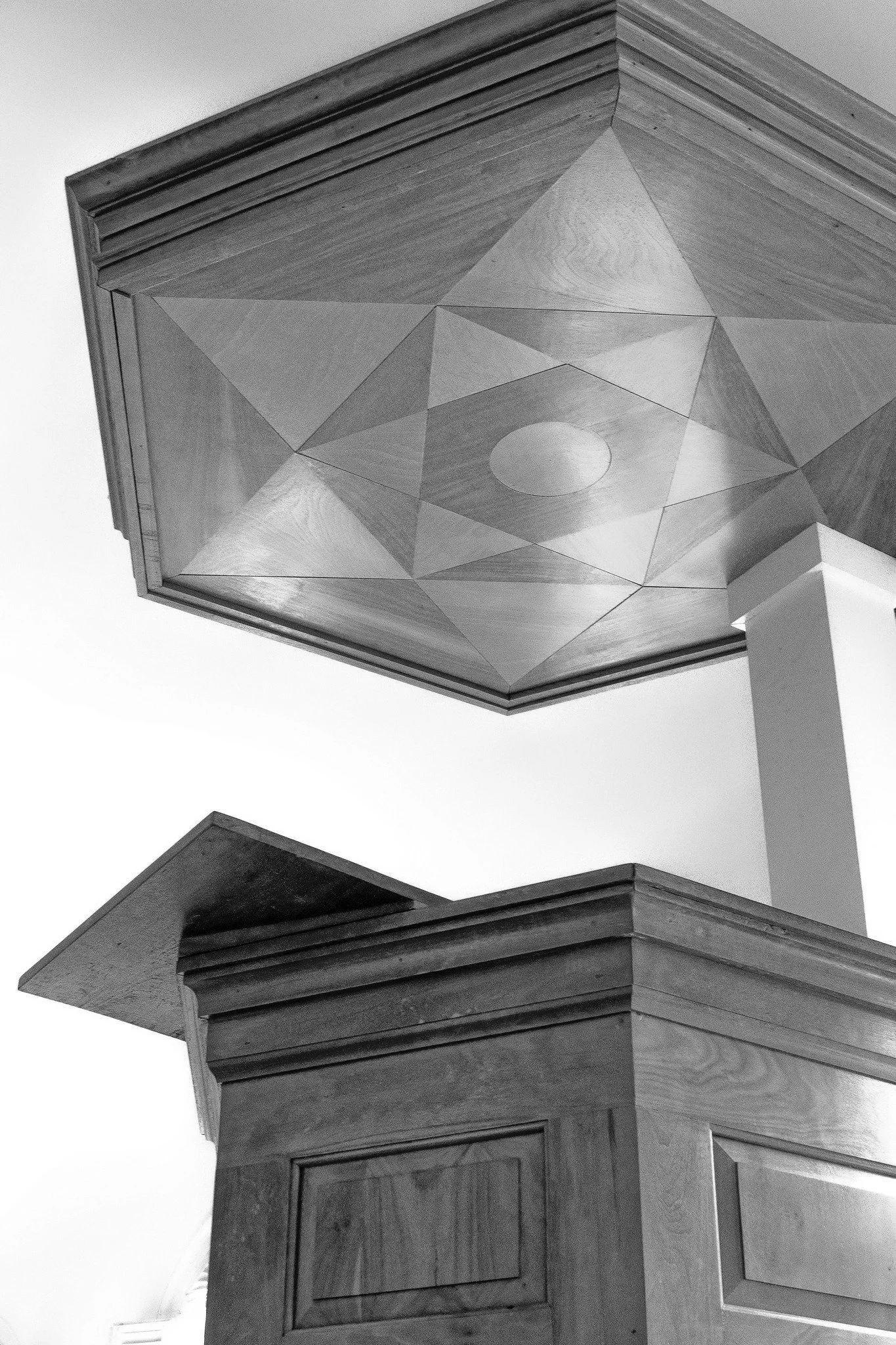
Pulpit, Old St. David’s Church, Cheraw, South Carolina
There is something powerful about looking up from the pews at Old St. David’s and seeing the pulpit not simply as furniture, but as witness.
From this place, Scripture, prayer, warning, comfort, and community memory have been spoken across generations. In the geometry of the woodwork and the quiet authority of the space, I see the Anglican inheritance of colonial South Carolina, but I also see something more personal: the way faith becomes rooted in place.
Old St. David’s was built at the edge of empire and revolution, under the last years of British authority in South Carolina. Yet what remains for me is not only the history of Crown and colony. It is the living memory of a church that still gathers, still speaks, and still reminds us that sacred places hold more than architecture. They hold the prayers of those who came before us.
Photograph by Ron Stafford.