“On a Dark Night”: St. John of the Cross and the Grace to Begin Again
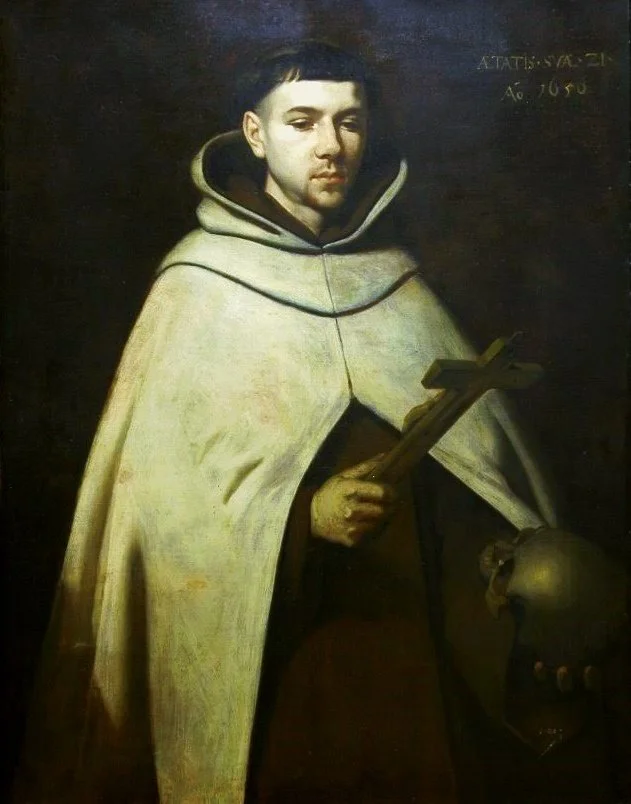
St. John of the Cross, attributed to Francisco de Zurbarán, 1656. Shown in the Carmelite habit and holding the crucifix, St. John is remembered as a mystic, poet, reformer, and Doctor of the Church whose writings gave enduring theological language to suffering, purification, darkness, and the soul’s longing for union with God (Wikimedia Commons, n.d.).
“On a dark night,
Kindled in love with yearnings,
Oh, happy chance!”
Those opening lines from St. John of the Cross’s Dark Night of the Soul do not sound the same to me anymore. I used to read them as mystical poetry, beautiful, ancient, and safely distant from my own life. Now I hear them differently. I hear them with the weight of a body that has already been through loss. I hear them from the edge of a wound care room. I hear them while facing the possibility that recovery may not be something I pass through once, but something I may have to enter again.
St. John of the Cross knew darkness, not as an idea, but as a lived reality. Born Juan de Yepes in sixteenth-century Spain, he entered the Carmelite order and became one of the great reformers of Carmelite life alongside St. Teresa of Ávila. His writings, especially The Ascent of Mount Carmel, The Dark Night, The Spiritual Canticle, and The Living Flame of Love, remain central texts in Christian mystical theology because they describe the soul’s movement through purification, detachment, suffering, and finally, deeper union with God (Egan, 1991; Kavanaugh & Rodriguez, 1991). He was not merely writing devotional encouragement. He was giving theological language to the soul when ordinary language fails.
That matters to me because ordinary language has started to fail me too.
How do you explain what it feels like to lose a leg, learn to live again, fight for recovery, finish a doctorate, keep showing up, and then realize you may be standing at the edge of another medical struggle? How do you explain the exhaustion of having already survived one life-altering season and now facing another? How do you explain what it feels like when the body that carried you through grief, school, work, faith, and survival asks you once again to stop, submit, heal, wait, and trust?
St. John’s darkness was not sentimental. During conflict over the Carmelite reform, he was imprisoned in Toledo in 1577 and held in harsh conditions by members of his own order. The darkness he wrote about was spiritual, yes, but it was also connected to deprivation, confinement, suffering, and the stripping away of everything that normally gives a person control (Kavanaugh & Rodriguez, 1991; McGinn, 2017). His poetry did not come from comfort. It came from a soul that had been pressed down and still reached toward God.
That is the part I cannot shake.
St. John did not teach that the dark night was simply sadness, depression, or ordinary hardship. In his theology, the dark night is a process of purgation, a painful purification in which God draws the soul beyond attachment to comfort, certainty, spiritual feelings, and self-reliance (John of the Cross, 1991; Payne, 1990). That does not make suffering good. It does not mean pain is holy just because it hurts. But it does mean that God can work in the darkness, even when the darkness itself is not what God desires for us.
I need that distinction right now.
I do not want to romanticize what I am going through. There is nothing poetic about medical fear. There is nothing mystical about wondering whether a wound will heal, whether another surgery is coming, whether my body will cooperate, or whether I have the strength to face another long road. There is nothing glamorous about bandages, blood sugar checks, doctor visits, disability, mobility challenges, or the mental fatigue of trying to stay hopeful while also being realistic.
And yet, this is where faith has to become more than language.
It is easy to speak of trust when the road is clear. It is harder when trust looks like taking the medicine, staying off the foot, asking the surgeon the hard questions, going back to wound care, watching the numbers, changing the dressing, and refusing to let fear make every decision. Some days my faith feels steady. Some days it feels like I am holding it together with medical tape and sarcasm. Some days prayer comes easily. Other days the only prayer I can manage is, “Lord, please help me do this one more day.”
I think St. John would understand that kind of prayer.
Job would too.
The Book of Job refuses to make suffering neat. Job does not sit in the ashes and offer polite religious clichés. He grieves. He argues. He questions. He demands to be heard. Yet in the middle of devastation, Job still declares, “For I know that my Redeemer lives” (Job 19:25, New Revised Standard Version Updated Edition). That line does not erase his pain. It does not explain everything. It does not give him his life back in that moment. It simply insists that suffering does not have the final word.
That is the kind of faith I am trying to practice right now. Not a faith that pretends I am not tired. Not a faith that denies fear. Not a faith that skips straight to triumph. A faith that can sit in the dark and still say, somehow, God is here. A faith that can admit, “I do not know what happens next,” and still keep moving toward the next right thing.
The Book of Common Prayer gives me words when my own words wear out. In the Ministration to the Sick, the Church prays that Christ will “sustain you with his presence” and give “life and peace” (The Episcopal Church, 1979, p. 456). That prayer feels different when sickness is not abstract. It feels different when the wound is real, the body is tired, and the future is uncertain. I do not only need healing in the medical sense, although I want that desperately. I need to be sustained. I need peace that can live beside fear. I need enough grace for one more appointment, one more dressing change, one more decision, one more morning.
That may be where St. John speaks to me most deeply. He does not promise that the dark night will be easy. He does not promise that God will always feel close. He does not promise that the soul will understand what is being stripped away while it is happening. What he offers is harder and holier: the possibility that God may still be drawing us forward even when we cannot see the path.
I am living in that tension now.
I am a scholar, but I do not have all the answers.
I am a person of faith, but I still get scared.
I am an amputee, but I am still learning what disability teaches and demands.
I have finished a doctorate, but I am still being schooled by pain, patience, and humility.
I have already survived one major loss, but now I may have to face another season of recovery.
And still, I am trying.
That is the sentence I keep coming back to.
I am still trying.
Trying to heal. Trying to pray. Trying to listen. Trying to trust the doctors without surrendering my voice. Trying to be honest about my fear without letting fear become my god. Trying to believe that my wounds can become witness, that my scholarship can become service, and that my life still has vocation even when my body feels fragile.
St. John of the Cross wrote of the soul going out into the night, drawn not by certainty, but by love. That is what I am holding onto. I do not know exactly what healing will look like. I do not know how long this road will be. I do not know what my body will require of me next. But I know this: darkness is not the same thing as abandonment.
St. John met God there.
Job cried out to God there.
The Church prays with the sick there.
And I am learning, slowly and stubbornly, to keep moving there too.
This is my dark night of the soul. It is medical. It is spiritual. It is physical. It is emotional. It is frustrating, frightening, humbling, and holy in ways I never asked for.
But it is not the end of my story.
By grace, I am still moving toward morning.
References
Egan, H. D. (1991). An anthology of Christian mysticism. Liturgical Press.
John of the Cross. (1991). The collected works of St. John of the Cross (K. Kavanaugh & O. Rodriguez, Trans.). ICS Publications.
Kavanaugh, K., & Rodriguez, O. (1991). Introduction. In John of the Cross, The collected works of St. John of the Cross(K. Kavanaugh & O. Rodriguez, Trans.). ICS Publications.
McGinn, B. (2017). The varieties of vernacular mysticism, 1350–1550. Herder & Herder.
Payne, S. (1990). John of the Cross and the cognitive value of mysticism: An analysis of Sanjuanist teaching and its philosophical implications for contemporary discussions of mystical experience. Springer.
The Episcopal Church. (1979). The Book of Common Prayer. Church Publishing.
Wikimedia Commons. (n.d.). Zurbarán (atribuido)-John of the Cross-1656.jpg.