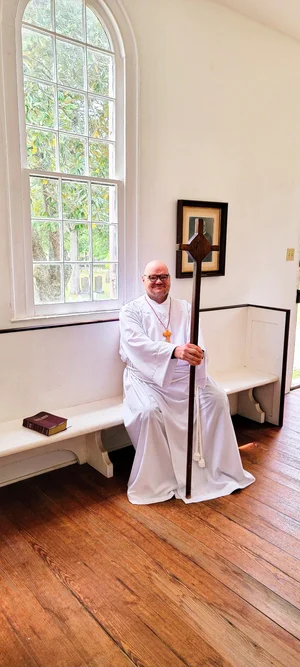
The Renaissance Man at Four in the Morning
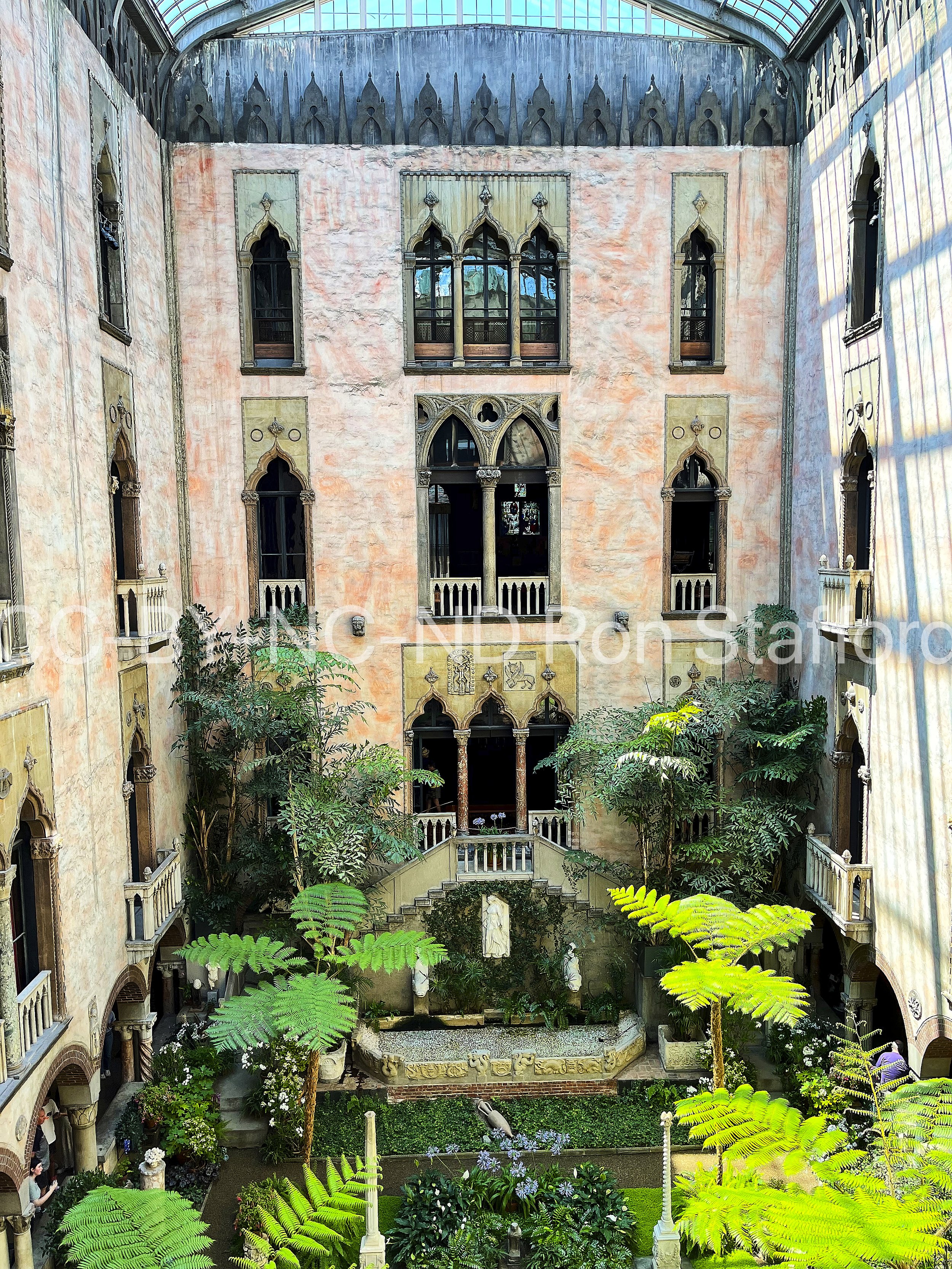
Courtyard, Isabella Stewart Gardner Museum, Boston, Massachusetts. The museum’s interior courtyard embodies Gardner’s distinctive approach to collecting and display, bringing architecture, sculpture, plants, light, and historic objects together as a unified aesthetic environment. More than a setting for her collection, the courtyard demonstrates Gardner’s belief that art should be encountered as part of a larger sensory and human experience. Photograph by Ron Stafford.
I am a bad insomniac. This means that at four in the morning, when sensible people are asleep, I sometimes find myself asking questions that probably should wait until daylight. Recently, I asked ChatGPT a question: Based on what you know about me, what historical figures am I most like, male and female, and which artists, male and female? I was not asking who had accomplishments comparable to mine. That would be absurd. I was asking about temperament, curiosity, personality, and the peculiar combination of interests that shape a person. The answers fascinated me: Thomas Jefferson, Isabella Stewart Gardner, John Singer Sargent, and Julia Margaret Cameron. Who was Virginia Woolf’s great aunt. Because this is my life, and Virginia Woolf is never very far from anything I think about, Mrs. Dalloway somehow entered the conversation as well. The more I considered these comparisons, the more I realized they were describing something I have spent much of my life becoming: a Renaissance man.
I use the term Renaissance man carefully. I do not mean someone who knows everything. In fact, the older I become and the more educated I become, the more conscious I am of how much I do not know. For me, being a Renaissance man means remaining unwilling to confine curiosity to a single discipline. My education reflects that tendency. I began with history and fine arts, then moved into library and information science, archives, preservation, technology, and eventually a doctorate in higher education leadership. Around those formal areas of study, I have built a life filled with photography, architecture, literature, theology, opera, museums, historic buildings, material culture, technology, old books, beautiful objects, churches, art, education, and an enduring fascination with memory. I have never understood why I should have to choose among them. To me, they are connected.
A historic building, for example, is never simply a beautiful building. It is architecture, but it is also history, politics, religion, economics, craftsmanship, material culture, preservation, photography, and memory. Inevitably, for me, it also becomes education. I want to know who built it, why it was built, what ideas shaped it, what objects once occupied it, what happened there, how it survived, and why it matters now. One question leads naturally to another. That intellectual restlessness may be the most Jeffersonian part of my personality.
Thomas Jefferson remains one of the great moral contradictions of American history. The man who wrote powerfully about human liberty also enslaved human beings and held racial beliefs that must remain central to any honest assessment of him. As a historian, I cannot separate intellectual admiration from moral scrutiny. However, when the comparison is limited to temperament, I understand Jefferson’s polymathic impulse. Books, architecture, education, gardens, history, science, art, languages, technology, politics, and material culture did not exist for him as entirely separate intellectual worlds. Neither do they for me. I can photograph an eighteenth-century church in the afternoon, become fascinated by a piece of furniture inside it, begin researching the architecture, wander into the history of the people who built it, think about how it should be preserved, and eventually arrive at the question of how we teach another person why any of it matters. To me, that progression feels entirely natural.
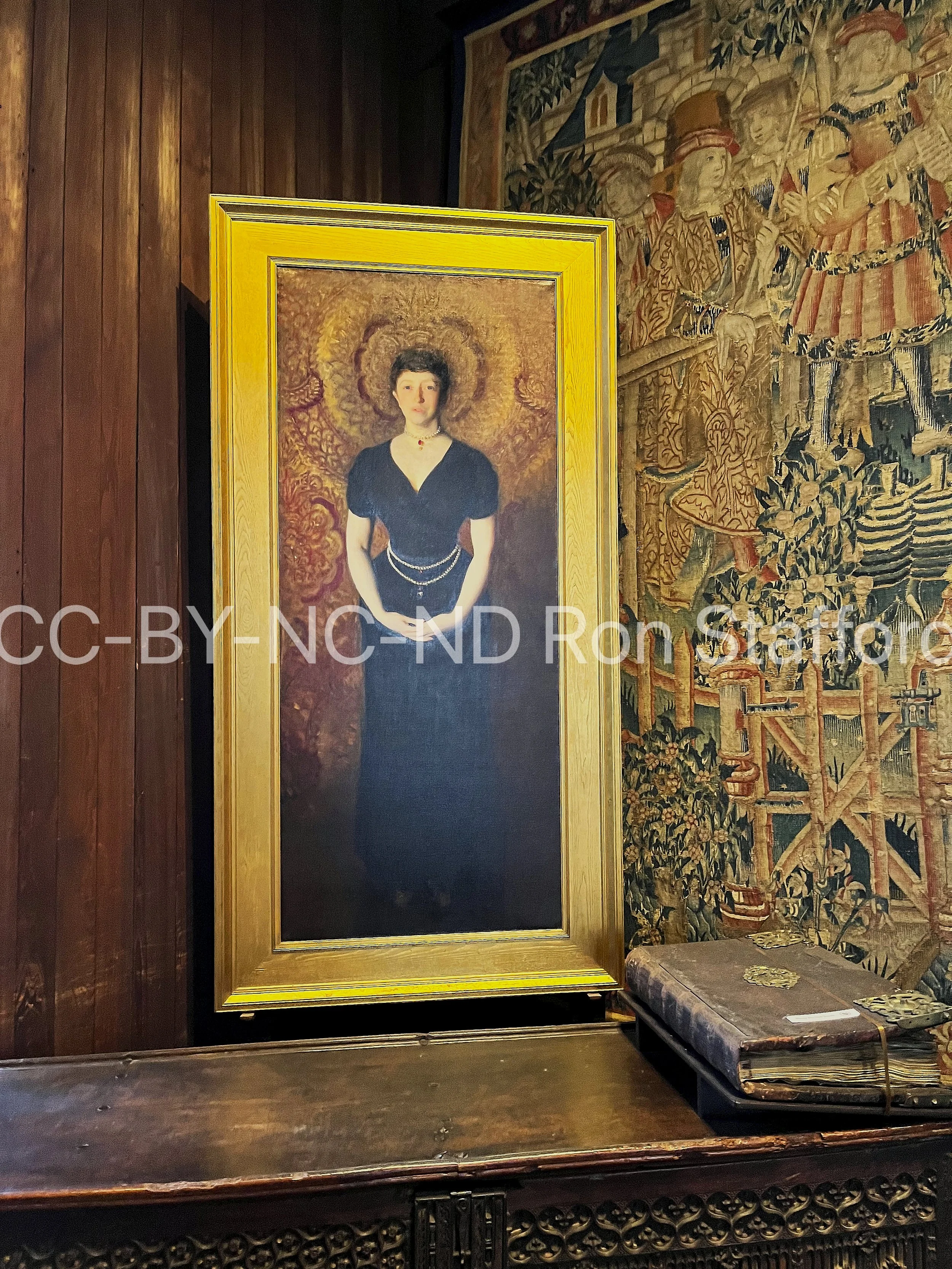
Portrait of Isabella Stewart Gardner, John Singer Sargent, 1888, Isabella Stewart Gardner Museum, Boston, Massachusetts. Sargent painted Gardner in a black evening gown against a richly patterned textile, producing an image as concerned with presence and personality as physical likeness. The portrait attracted considerable attention and gossip in Gilded Age Boston. Its placement within Gardner’s own museum now creates an unusual encounter between collector, artist, collection, and viewer: Gardner herself becomes part of the world she assembled. Photograph by Ron Stafford.
Then there is Isabella Stewart Gardner, and perhaps Gardner comes even closer to something essential about my personality. Gardner did not merely collect art. She created experiences around it. Paintings existed alongside architecture, furniture, textiles, gardens, books, music, flowers, conversation, and human presence. Beauty was not something to be isolated behind glass. It was something to live among. I understand that instinct immediately. I love art, opera, architecture, museums, historic places, books, and beautiful objects, but merely possessing or understanding them has never been enough for me. I want somebody else to see them.
I have taken people to their first art museum. A dear friends father once said, I would take Satan to the Mint Museum. I have taken many people to their first opera. Some of my favorite cultural memories are not simply of the painting, building, or performance itself, but of watching another person encounter something extraordinary for the first time. There is a curatorial instinct buried deeply in my personality that says, “Come here. Look at this. Let me tell you why it matters.” That may be one of the most concise descriptions of me I have encountered. It is the historian in me, the archivist, the librarian, the educator, the photographer, and, increasingly, the host. I have come to believe that culture can be a form of hospitality. Knowing something is wonderful, but inviting another person into that knowledge can be even more meaningful.
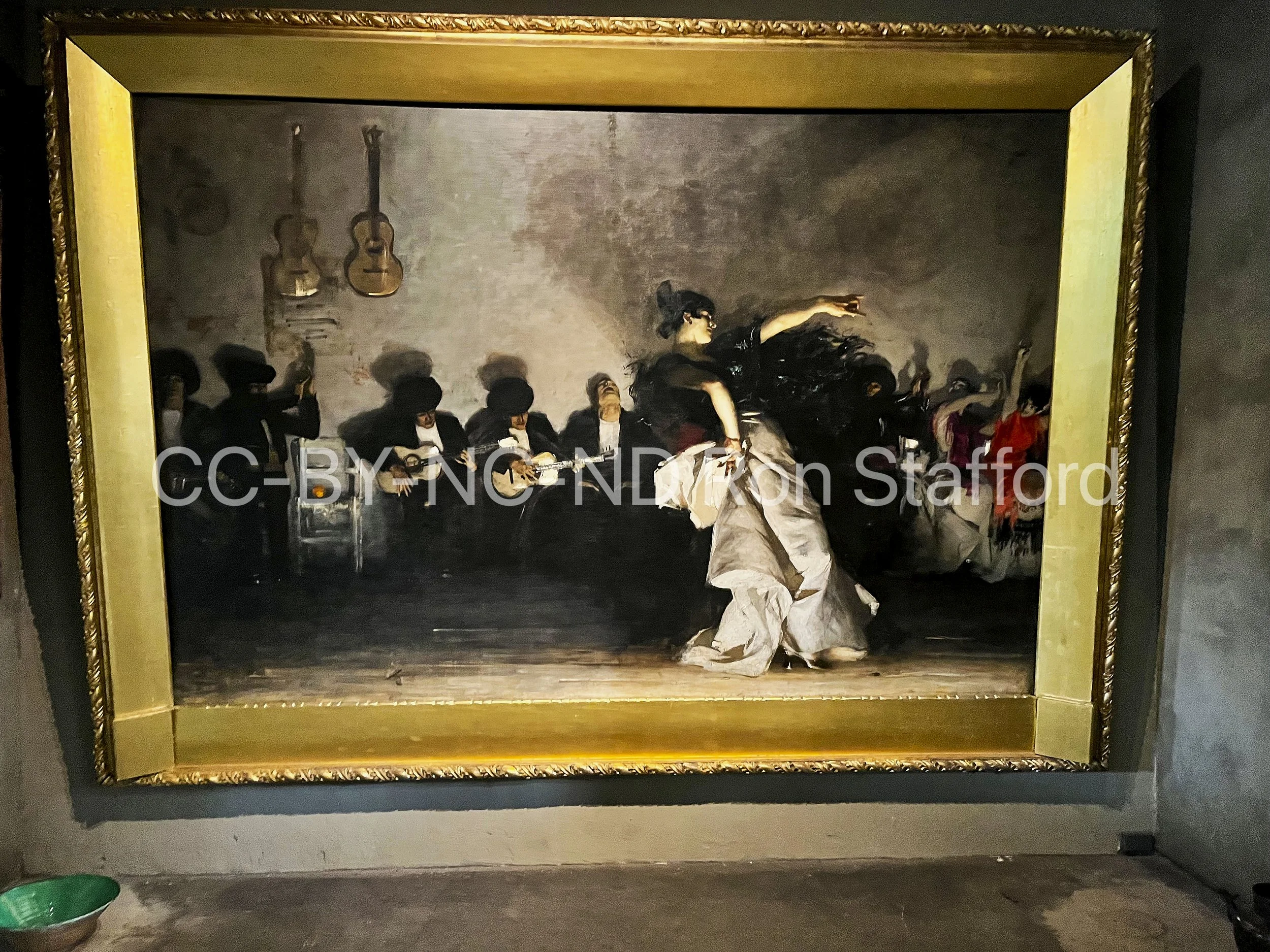
El Jaleo, John Singer Sargent, 1882, Isabella Stewart Gardner Museum, Boston, Massachusetts. Sargent’s monumental depiction of a Spanish dancer is installed in the Spanish Cloister, an environment Isabella Stewart Gardner specifically designed for the painting. Rather than presenting El Jaleo as an isolated object, Gardner surrounded it with architectural and decorative elements that evoke Spain, transforming the act of viewing into an immersive experience—an especially powerful example of her curatorial philosophy. Photograph by Ron Stafford.
John Singer Sargent makes sense to me for a different reason. Sargent was cosmopolitan, cultivated, and socially perceptive, but what fascinates me about his portraits is not simply their elegance. It is their presence. His subjects seem to occupy their paintings rather than merely appear in them. They are not just visual records of faces. Somehow, Sargent captured something about the experience of encountering another human being. As a photographer, I understand that desire. A technically perfect photograph that says nothing does not interest me nearly as much as an imperfect photograph that preserves something real: a gesture, a face, a room, a particular quality of light, the way someone inhabited a place, or the evidence that, for one fraction of a second, this happened.
That idea leads naturally to Julia Margaret Cameron, who may be the most revealing comparison of all. Cameron’s world brought together photography, literature, spirituality, history, beauty, intellectual society, theatricality, and an intense awareness of human mortality. Her photography was not simply documentary. She wanted the camera to reveal something interior. Her life also resisted compartmentalization. Art, literature, religion, friendship, hospitality, and intellectual conversation existed together. That mixture feels strikingly familiar to me because beneath many of my interests there may be one recurring concern: preservation against time.
Photography preserves a moment. Archives preserve evidence. Libraries preserve knowledge. Historic preservation protects places. History preserves stories. Writing preserves thought. Art preserves ways of seeing. Ritual preserves communal memory. Even education can be understood as a form of preservation because it takes what one generation has learned and places it into the hands of another. Repeatedly, I seem to return to the same fundamental problem: Time takes things away. What can we preserve before they are gone? Perhaps that is why I became an archivist. Perhaps it is why I became a photographer. Perhaps it explains why I can stand inside an old church and become deeply conscious of all the people who occupied that same space before me.
Then, inevitably, Mrs. Dalloway enters the room. Virginia Woolf begins Mrs. Dalloway with one of my favorite sentences in English literature: “Mrs. Dalloway said she would buy the flowers herself” (Woolf, 1925/2021, p. 3). I think I understand Clarissa Dalloway more as I grow older. Her gift is gathering. She gathers people, but she also gathers memory, beauty, conversation, flowers, rooms, and moments. She creates a space in which otherwise separate lives briefly encounter one another. Suddenly, I can see the thread that connects all of these comparisons. Jefferson gathers knowledge. Gardner gathers beauty. Sargent gathers presence. Cameron gathers memory. Mrs. Dalloway gathers people. I suppose I have spent much of my own life gathering all five.
That may be my particular version of the Renaissance man. It is not someone who masters every discipline. It is someone who refuses to believe the disciplines were ever truly separate in the first place. I am a historian and an archivist, a librarian and an educator, a photographer, and a Doctor of Education who can become completely distracted by an eighteenth-century chair. I am a lover of technology who surrounds himself with old books. I can talk about digital equity in higher education and then become equally animated discussing Palladian architecture, Virginia Woolf, opera, theology, photography, archives, or why a particular piece of china belongs on a particular table. I am independent enough to have stopped worrying very much about whether all of these interests are supposed to belong to the same person. They do because they belong to me.
I like beautiful things, but I do not want merely to possess them. I want to understand them. I want to know where they came from, who made them, who touched them before me, and what they meant to the people who lived with them. I want to photograph them, preserve them, write about them, teach with them, and then bring somebody else into the room and say, “Come here. You must see this.” Perhaps that is the thread connecting the historian, archivist, educator, photographer, aesthete, and host in me. I am interested in the things human beings create because I am fascinated by the traces we leave behind: a building, a painting, a photograph, a book, a piece of music, a ritual, a memory, a conversation, or a life.
Perhaps being a Renaissance man in the twenty-first century is not about having all the answers. Perhaps it is about remaining endlessly curious about the questions. Somewhere in my imaginary house at four in the morning, Jefferson is in the library examining the books. Gardner is rearranging the art because she does not like how I have hung it. Sargent is quietly studying everyone in the room. Cameron has found the camera and is trying to capture something the rest of us cannot quite see. Virginia Woolf is sitting near a window observing the entire scene and will undoubtedly write something devastating about all of us later. Mrs. Dalloway, meanwhile, has noticed the one thing everyone else overlooked: There are no flowers. So, I suppose I will have to buy them myself.
Reference
Woolf, V. (2021). Mrs. Dalloway. Vintage Classics. (Original work published 1925)