The Ruins Keep the Old Prayers: Nature, Faith, Education, and the Shape of My Soul
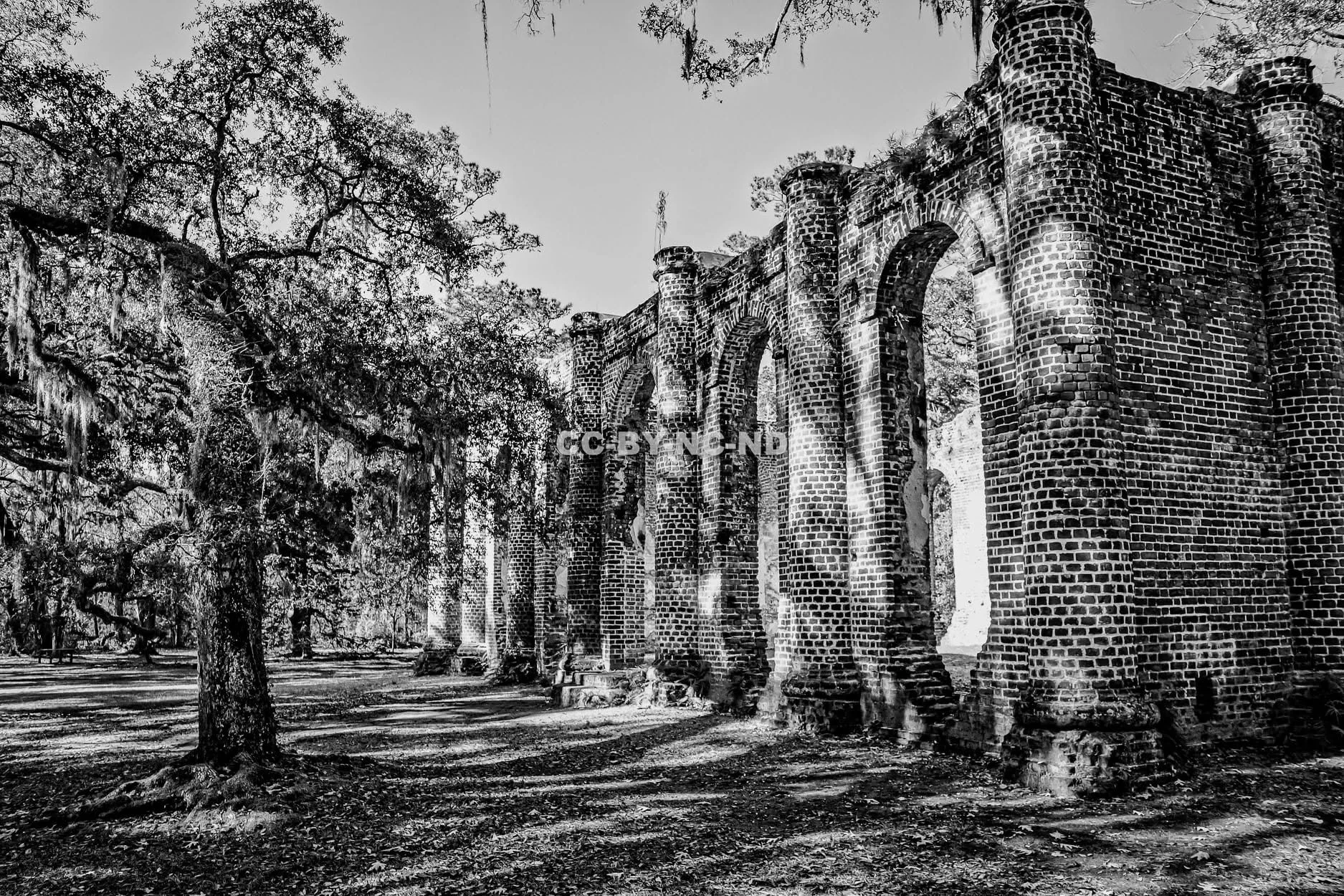
Where the roof has fallen away, the heavens moved in. These old brick arches, held by moss, shadow, and Southern light, remind me that beauty does not always arrive polished. Sometimes it stands wounded, weathered, and stubborn — still lifting itself toward God while the trees keep the old prayers.
Photo: Ron Stafford
Some people look at ruined brick arches beneath live oaks and see decay.
I look at them and feel recognition.
This photograph is not just an image of an old ruin. It is a mirror of the way my soul moves through the world. Brick, moss, shadow, light, trees, silence, these things speak to me more clearly than noise ever has. I have always been drawn to places where nature and memory meet. Give me a ruin under a canopy of trees, a graveyard softened by moss, a church window filled with afternoon light, or a dirt road disappearing into green shade, and something in me becomes quiet enough to listen.
That is the great truth at the center of my worldview: I am drawn to natural beauty because I believe nature tells the truth.
Nature does not hurry. It does not flatter. It does not pretend the old wall is not cracked or the tree is not scarred. It simply keeps growing. It wraps itself around what has been broken and, over time, teaches even the ruin how to belong.
This photograph shows that mystery. The brick arches are wounded by time, but they are not without dignity. The roof is gone, but the sky has become the ceiling. The trees have entered the scene not as invaders, but as caretakers. The moss hangs like old lace. The shadows fall like memory. The whole place feels less abandoned than gathered back into the hands of God.
That is why I think my worldview is Romantic in the deeper artistic and spiritual sense. Not sentimental. Not decorative. But Romantic in the belief that beauty carries meaning, that nature speaks to the inner life, that ruins can teach, and that the soul needs more than usefulness to survive.
William Wordsworth wrote that poetry is “the spontaneous overflow of powerful feelings,” formed through “emotion recollected in tranquillity” (Wordsworth, 1802/1991). That line feels close to how I experience both art and life. I often do not understand what something means while I am standing in the middle of it. I understand later, in quiet. I understand when I look back. I understand when nature has slowed me down enough to hear what my own life has been trying to say.
The natural world has always been a kind of chapel for me. I do not mean that it replaces church. It does not. But it prepares me for worship. Trees, rivers, old cemeteries, ruins, fields, and weathered churchyards tune the soul. They remind me that God’s creation is not background scenery. It is revelation.
In nature, I see patience.
In ruins, I see endurance.
In light, I see mercy.
In moss and roots, I see the slow, stubborn work of grace.
That is also how I understand education.
For me, education has never been merely the transfer of information. Education is formation. It is the sacred work of helping people grow toward the light. A student is not a number, a grade, a retention statistic, or a problem to be managed. A student is a living soul, often carrying more than anyone knows.
My years in libraries taught me that people rarely come looking only for a book, a database, a citation, or a password reset. They come looking for a way forward. Sometimes the official question is about research. The deeper question is: Can I still do this? Do I belong here? Is there a path for me?
That is where my love of natural beauty shapes my approach to education. Nature teaches that growth does not happen by force alone. It requires the right conditions. Soil matters. Light matters. Water matters. Shelter matters. Time matters.
Students are the same way.
A student struggling with unreliable internet is not lazy. A rural adult learner trying to complete coursework from a parking lot is not simply an “access issue.” That student is trying to grow in poor soil. My work in digital equity and rural student persistence has shown me that success is not just about motivation. It is about whether the institution has created the conditions where a human being can flourish.
John Keats described “Negative Capability” as the ability to remain “in uncertainties, Mysteries, doubts” without rushing toward easy answers (Keats, 1817/2009). That idea matters deeply to education. Real student success work requires us to sit with complexity. It requires us to notice the hidden barriers. It requires us to resist the temptation to reduce a person’s struggle to a clean explanation.
A Romantic approach to education says: look closer.
Look at the whole person.
Look at the landscape around the learner.
Look at what is blocking the light.
That is what nature has taught me. Growth is never separate from environment. A tree planted in poor ground cannot be judged the same way as one planted beside water. A student without access, support, confidence, or stability cannot be judged as though all conditions are equal.
Education, at its best, becomes the work of cultivation.
We clear paths.
We open gates.
We tend roots.
We make room for light.
This same worldview shapes my religion. Christianity, at least the Christianity that has kept hold of me, is not a faith of polished surfaces. It is a faith of wounds, soil, bread, wine, water, wood, stone, body, blood, death, and resurrection. It is an earthy faith. A faith that begins in a garden, walks through wilderness, breaks bread at tables, dies on a tree, and rises in a garden again.
That is why this ruined church speaks to me.
The walls are broken, but they still point upward. The roof is gone, but heaven has not moved. The brick is scarred, but the shape remains. It feels like a place where faith has been weathered but not erased. It is not perfect. It is not polished. It is holy in the way old things become holy when time, grief, and grace have all passed through them.
There is something deeply Southern Gothic in that: grace with Spanish moss on it, resurrection with dirt under its nails, salvation that knows where the graves are and still brings flowers.
Percy Bysshe Shelley wrote that poets are “the unacknowledged legislators of the world” (Shelley, 1840/2002). I understand that increasingly. The poet, the teacher, the librarian, the preacher, the artist, all shape how people see. We teach what is worth noticing. We help others recognize meaning where the world has trained them to see only usefulness, damage, or inconvenience.
That is what I want my life and work to do.
I want to help people notice the sacred in the ordinary.
I want to help students see that their lives are not finished because they have struggled.
I want to help institutions remember that access is not charity; it is justice.
I want to keep teaching, writing, photographing, and serving from the belief that beauty can still rise out of broken ground.
And then there is Beethoven.
If Wordsworth gives me nature as memory, Keats gives me mystery, and Shelley gives me imagination as moral force, Beethoven gives me the sound of the soul refusing to die.
Beethoven may be the great musician of this worldview because his music does not float above suffering. It passes through it. In the Heiligenstadt Testament, written as he faced the devastation of his hearing loss, Beethoven confessed that art held him back from despair because he still felt there was work within him that had to be brought forth (Beethoven, 1802/2012).
That is the sound of a life refusing to be reduced to its wound.
I understand that.
After illness, amputation, recovery, and the long, strange pilgrimage back toward myself, I know something about ruins. I know what it means to feel altered by life and still sense that something beautiful remains. I know that survival and living are not the same thing. Survival keeps the body moving. Living asks what the soul is still called to love.
For me, the answer keeps returning through beauty.
Through trees.
Through old churches.
Through books.
Through music.
Through students finding their courage.
Through worship.
Through ruins that refuse to fall.
This is why my worldview is Romantic. I believe the world is charged with meaning. I believe nature is one of God’s oldest languages. I believe beauty is not decoration; it is nourishment. I believe students carry hidden cathedrals within them. I believe faith is often found not in perfection, but in the places where light enters through what has been broken open.
So, when I look at this photograph, I do not see merely an old wall.
I see my own theology.
I see my educational philosophy.
I see the landscape of my soul.
The arches remain.
The trees keep watch.
The light enters through absence.
The old prayers are still there, caught in brick, moss, shadow, and leaf.
And my soul, stubborn as ever, is still drawn toward them.
References
Beethoven, L. van. (2012). Beethoven’s complete Heiligenstadt Testament. National Arts Centre Canada. Original work published 1802.
Keats, J. (2009). Selections from Keats’s letters. Poetry Foundation. Original letter written 1817.
Shelley, P. B. (2002). A defence of poetry. In D. H. Reiman & N. Fraistat (Eds.), Shelley’s poetry and prose. W. W. Norton. Original work published 1840.
Wordsworth, W. (1991). Preface to Lyrical Ballads. In R. L. Brett & A. R. Jones (Eds.), Lyrical Ballads (2nd ed.). Routledge. Original work published 1802.