

Two Doctors at the Foot of the Cross, Edith Stein, Faith, Scholarship, and the Work of Being Wounded
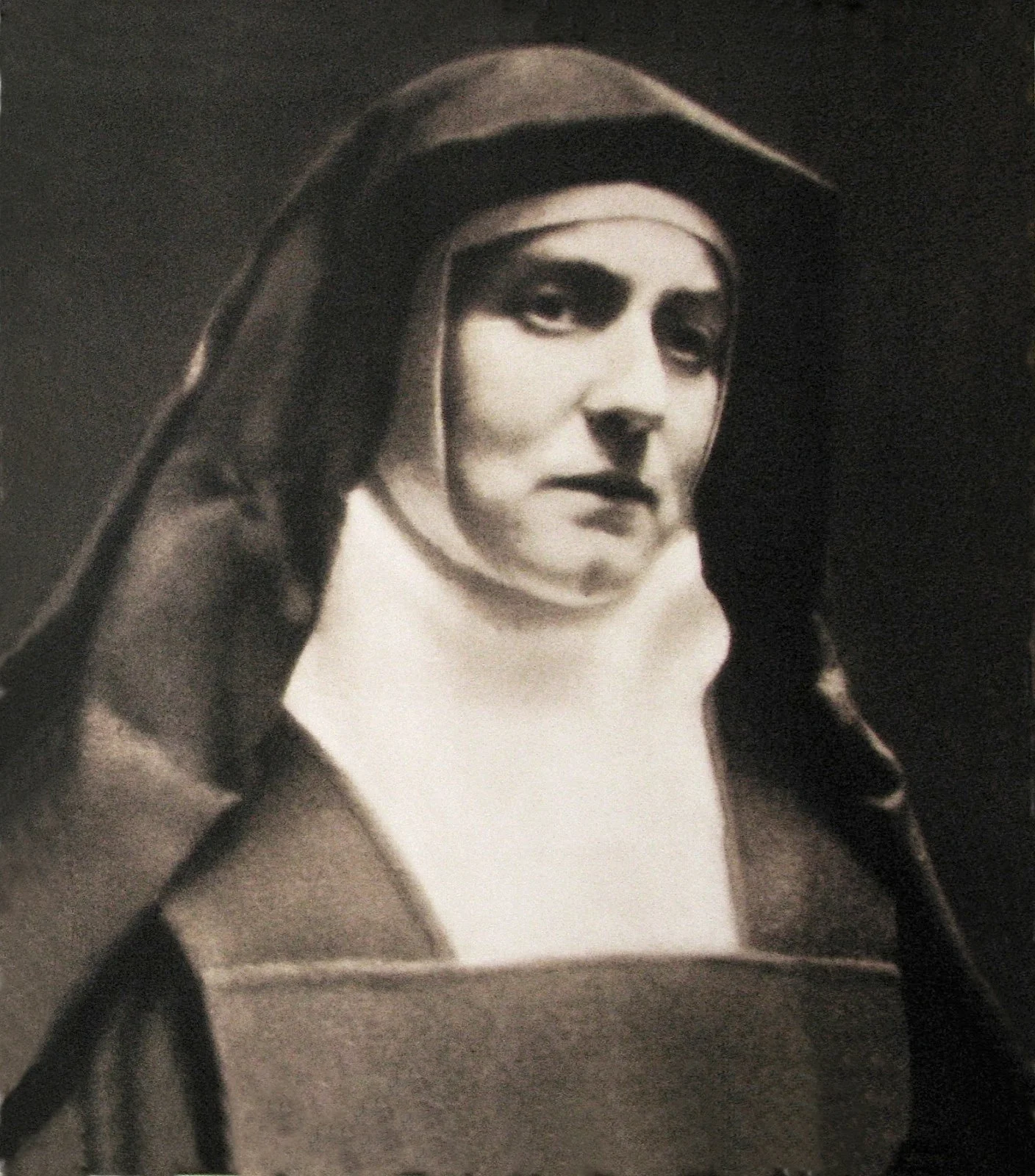
Figure 1
St. Teresa Benedicta of the Cross, Edith Stein, ca. 1938–1939. This photograph, often described as a passport photo, was taken before Stein moved from Cologne to Echt in the Netherlands. Stein was a philosopher, Discalced Carmelite nun, martyr, and saint whose life continues to shape my understanding of faith, scholarship, suffering, and vocation. Note. Photograph from Wikimedia Commons (n.d.).
There are saints we admire from a distance, and then there are saints who seem to sit down beside us in the dark and refuse to let us pretend our pain is meaningless. For me, Edith Stein, known in religious life as St. Teresa Benedicta of the Cross, is one of those saints.
Her life has followed me, or maybe I have followed hers. Edith Stein was born into a Jewish family in Breslau in 1891. She became a philosopher, studied with Edmund Husserl, and earned her doctorate with a dissertation on empathy, a subject that would become one of the defining themes of her intellectual life (Szanto, 2020). Later, after her conversion to Christianity, she entered the Discalced Carmelite order in Cologne in 1933 and took the name Teresa Benedicta of the Cross, Teresa, blessed by the Cross (Vatican, n.d.). She was killed at Auschwitz in 1942 and canonized by Pope John Paul II in 1998 (Vatican, n.d.).
That name alone stops me, blessed by the Cross.
Not blessed because life was easy. Not blessed because suffering was romantic. Not blessed because pain was somehow holy in itself. Blessed because the Cross, when carried with Christ, becomes something more than destruction. It becomes witness. It becomes surrender. It becomes the place where God does not explain every wound, but refuses to abandon us inside it.
I have thought about Edith Stein often during my own dark night of the soul. My journey has not been hers. I would never compare my suffering to the horror she endured, nor would I want to flatten her Jewish identity, her martyrdom, or the historical violence of the Holocaust into a metaphor for my own life. Her story deserves reverence, not casual comparison. But saints become companions because they teach us how to walk through our own particular darkness with more courage, more honesty, and more faith.
And there is one connection that feels especially meaningful to me, we are both doctors.
Edith Stein was a doctor of philosophy. I am a doctor of education. She used her mind to search for truth, dignity, empathy, and the meaning of the human person. I used mine to study the digital divide and the ways rural, nontraditional students fight for access, persistence, and educational opportunity. Her scholarship asked what it means to truly understand another person. Mine asked what happens when institutions fail to understand the lived realities of students trying to learn without reliable internet, transportation, money, or support.
Different centuries. Different fields. Different burdens. But still, two doctors asking, in our own ways, what does it mean to see the human being fully?
That is one of the reasons Edith Stein inspires me. She reminds me that scholarship is not supposed to be cold. It is not supposed to be detached from suffering. The best scholarship has a soul. It pays attention. It listens. It kneels close enough to the pain of others to say, “I believe you. Your experience matters. Your struggle deserves to be named.”
That is what I tried to do in my dissertation. I did not simply study internet access as a technical problem. I studied it as a human problem. I listened to students whose lives were shaped by weak signals, long drives, parking-lot Wi-Fi, timed assignments, and the quiet shame of trying to succeed in systems that often assume everyone has the same tools. In that work, I found my own version of empathy, not as sentimentality, but as disciplined attention. Stein’s philosophical work on empathy matters here because she treated empathy as a way of apprehending the other person as real, not as an object, problem, or abstraction (Szanto, 2020).
That is also where my own life and her witness meet in a more personal way.
At one point, I discerned whether I was called to become a Carmelite. Something about Carmelite thought drew me deeply, the silence, the prayer, the beauty of hiddenness, the fierce interior life of St. Teresa of Ávila, St. John of the Cross, and Edith Stein herself. There was a season when I wondered whether God might be calling me into that particular form of life. In the end, I came to understand that becoming a Carmelite was not my path, not because Carmelite thought failed to speak to me, but because God seemed to be calling me to carry its lessons into another kind of vocation.
I may not have been called to become a Carmelite, but I do believe I was marked by Carmelite thought.
Carmelite thought taught me that prayer and suffering are not separate from service. It taught me that silence can become strength. It taught me that the hidden life still matters. Edith Stein entered the Carmelite order at a time of escalating violence and danger. The Vatican’s biography presents her religious life not as an escape from suffering, but as a deeper participation in the Cross and in intercession for the world (Vatican, n.d.). That matters to me because I have had to learn that retreat, reflection, illness, and even disability do not remove a person from service. Sometimes they reshape the service.
That is where my own handicap enters this story.
I am learning, sometimes painfully, that the body has its own theology. A wound can preach. A wheelchair can become a classroom. A hospital room can become a chapel. The fear of amputation, the uncertainty of healing, and the daily practical limits of disability have forced me to see life differently. I do not say that lightly. I do not believe suffering is good simply because it exists. But I do believe that God can take what wounds us and turn it into a ministry of recognition.
Like Edith Stein, I feel called to combine faith, scholarship, and embodied suffering in service to others. Her path brought together philosophy, Christian faith, Jewish identity, Carmelite spirituality, and the Cross. My path brings together education, digital equity, library work, Episcopal faith, disability, and a deepening sense that God may still be asking something of me. Not in spite of my wounds. Maybe, mysteriously, through them.
That is not the same as saying suffering is noble. Some suffering is just exhausting. Some of it is frightening. Some of it makes you want to bargain with God, argue with God, and then sit quietly because you do not have any more words. But Edith Stein helps me believe that suffering can be consecrated without being sugarcoated. She helps me believe that the Cross does not erase pain; it transforms what pain can become.
As someone rooted in the Episcopal Church, active in parish life, and discerning where God may be calling me next, I am drawn to saints who do not make faith look simple. Edith Stein’s path was intellectual, mystical, costly, and embodied. She did not abandon the life of the mind when she entered deeper faith. She brought her mind with her. She did not stop being a scholar to become holy. Her scholarship became part of her holiness.
That gives me hope.
Because I do not believe God wastes our learning. I do not believe my doctorate is just a credential to hang on a wall or a line to add after my name. I believe it is a tool. A responsibility. Maybe even an offering. Edith Stein helps me see that being a doctor is not only about expertise. It is about vocation. It is about what we do with the knowledge we have been given. It is about whether our education makes us more compassionate, more courageous, and more willing to stand with those whose lives are marked by struggle.
And now, as I face my own uncertainty, health fears, possible amputation, questions about my future, and the strange grief of not knowing what my body or my calling will look like next, I find myself returning to her name again, Teresa Benedicta of the Cross.
Blessed by the Cross.
I am not always ready to say that. Some days I am frustrated. Some days I am afraid. Some days I am angry that the body I have carried this far may require me to surrender more than I ever expected. But Edith Stein does not ask me to pretend. She does not hand me shallow comfort. She simply points toward Christ and reminds me that the Cross is not the end of the story.
For her, the Cross was not an escape from the world’s suffering. It was the place where she met it honestly. That is the kind of faith I am trying to grow into, not a faith that denies the dark, but one that carries a small, stubborn light into it.
I think that is why she matters so much to me now. She was a scholar who became a saint. A doctor who became a witness. A woman of intellect who understood that truth without love is incomplete. Her life tells me that the mind and the soul are not enemies. Research and prayer can belong together. Academic work and sacred calling can speak to one another. A dissertation, a hospital room, a wound, a sermon, a classroom, and a chapel can all become places where God asks the same question:
Will you let this suffering become love?
I do not know exactly what comes next for me. I know what I have survived. I know what I have studied. I know what I believe God has placed in me. And I know that, like Edith Stein, I want my work and my wounds to mean something beyond myself.
We are both doctors, she, a doctor of philosophy, I, a doctor of education.
But more than that, we are both students of the Cross.
And I am still learning.
References
Szanto, T. (2020). Edith Stein. In E. N. Zalta (Ed.), The Stanford encyclopedia of philosophy. Stanford University. https://plato.stanford.edu/entries/stein/
Vatican. (n.d.). Teresa Benedict of the Cross, Edith Stein, 1891–1942. https://www.vatican.va/news_services/liturgy/saints/ns_lit_doc_19981011_edith_stein_en.html
Wikimedia Commons. (n.d.). Edith Stein, ca. 1938–1939 [Photograph]. In Wikimedia Commons. Retrieved May 5, 2026, from https://commons.wikimedia.org/wiki/File:Edith_Stein_(ca._1938-1939).jpg
.jpg)