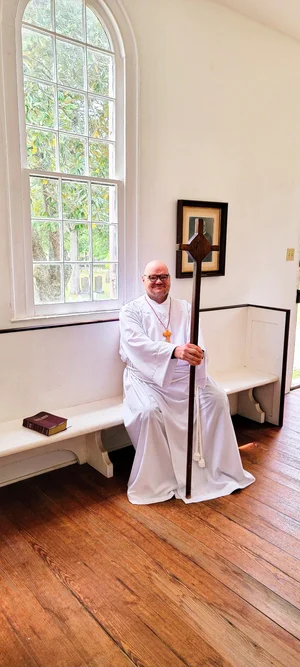
Broken, But Still Standing: Prince Frederick’s Church, the Pee Dee River, and the Faith That Keeps Us Upright
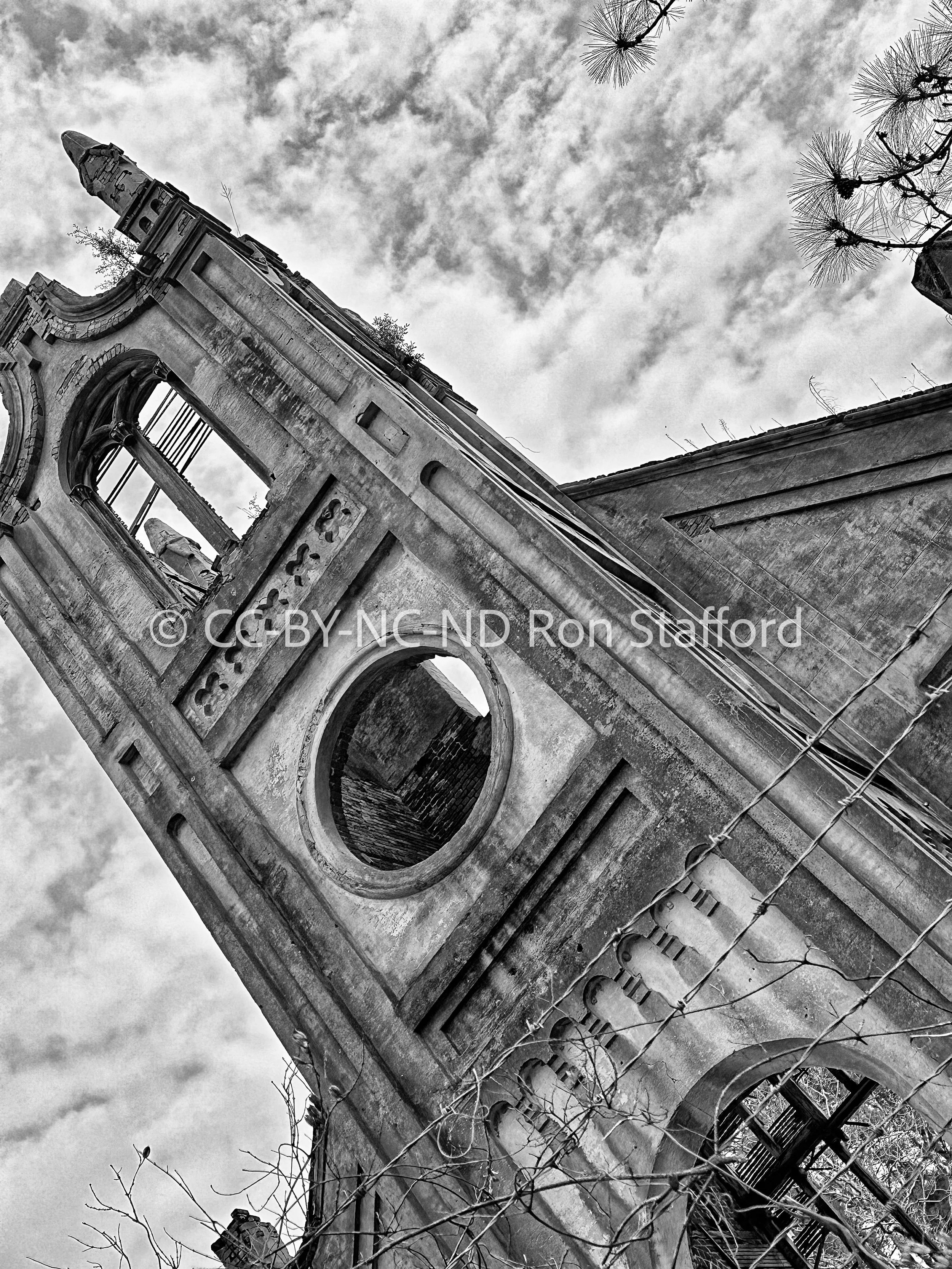
Prince Frederick’s Church, Plantersville, South Carolina — broken open to the sky but still preaching in stone.
Photo by Ron Stafford, CC BY-NC-ND.
There are ruins that look dead, and then there are ruins that look like they are still praying.
Prince Frederick’s Church in Plantersville, South Carolina, belongs to the second kind. It does not stand whole. It does not pretend otherwise. Its windows are empty. Its walls are scarred. Its Gothic arches point upward with the stubborn dignity of an elderly Anglican aunt who has seen three wars, six bad bishops, and one truly unforgivable casserole at coffee hour.
The roof is gone. The congregation is long scattered. The old rice world that helped build it has collapsed into history, moss, and footnotes. And yet there it remains: broken, yes, but not erased.
At this moment in my own life, I understand that more than I care to admit.
Prince Frederick Parish was created in 1734 after being divided from Prince George Winyah Parish, placing it within the older Anglican geography of colonial South Carolina (Prince George Winyah Parish Church, n.d.; South Carolina Picture Project, n.d.). The ruins photographed here are associated with the later chapel begun in 1859 and completed in 1876, its construction interrupted by the Civil War and by the unraveling of the rice-plantation economy that had shaped Georgetown County and the lower Pee Dee world (South Carolina Department of Archives and History [SCDAH], n.d.; National Trust for Historic Preservation, 2016).
That timeline alone feels like a sermon: a cornerstone laid before catastrophe; a church finished after the world that imagined it had already broken.
And because this is South Carolina, naturally there is a river involved. We do not do identity here without at least one river, three ghosts, a family story, and somebody mispronouncing a place name with great confidence.
For me, the connection between Georgetown and Cheraw is not abstract. It is not just a line on a map. It is the Great Pee Dee River, that long, brown, winding artery of memory that ties the inland Pee Dee to the coast. The river begins far above us as the Yadkin in North Carolina, becomes the Pee Dee near Cheraw, and eventually makes its way down toward Winyah Bay at Georgetown (South Carolina Picture Project, n.d.). Cheraw sat at the head of navigation on the Great Pee Dee, which made it an important trading point and regional crossroads (Advisory Council on Historic Preservation, n.d.). Georgetown, at the other end of that watery road, became one of the great ports and rice centers of colonial and antebellum South Carolina.
So, when I stand before Prince Frederick’s ruins, I do not feel as if I have wandered into someone else’s story. I feel as if I have followed the river home.
Cheraw and Georgetown are not merely two towns with charming old buildings and enough humidity to make your ancestors complain from the grave. They are bound by the Pee Dee. Goods moved along that river. People moved along it. Ideas, politics, prayers, wealth, suffering, and family histories moved along it. The upper Pee Dee and the Georgetown low country were part of the same cultural and economic watershed. The river connected courthouse towns, plantations, churches, ports, markets, and families. It carried produce and ambition downstream. It carried news and influence back inland. It made Cheraw more than a small interior town and Georgetown more than a coastal port. It made them kin.
And kinship, as any Southerner knows, is never simple. It arrives with beauty, obligation, pride, guilt, and at least one cousin who insists the family Bible was “somewhere in the attic” until the attic mysteriously vanished during a move in 1987.
Prince Frederick’s Church belonged to that Pee Dee world. It served a community tied to rice plantations along the rivers of Georgetown County, especially the Pee Dee and Waccamaw. The Pee Dee River Rice Planters Historic District preserves traces of that plantation landscape, including rice fields, buildings, and sites connected to a rice culture that flourished from roughly 1750 into the early twentieth century (SCDAH, n.d.). Scholars of the Carolina rice coast have emphasized how central rice was to Georgetown District’s economy, with Georgetown producing a remarkable share of South Carolina’s rice before the Civil War (Kovacik, 1979). But any honest telling must say plainly that this wealth was created through enslaved labor. These rivers carried not only commerce, but also the moral weight of bondage.
That is what makes this church so powerful and so unsettling. Its Gothic arches are beautiful. Its history is not innocent. Its walls speak of faith, but also of a world ordered by hierarchy, empire, plantation wealth, and human suffering. The ruin refuses to let us have a clean story. It will not allow us to say only, “How lovely.” It also demands that we say, “How costly.”
That may be why it feels so human.
We are all, in one way or another, ruins with commentary.
Some of us just have better lighting.
Since March, I have lived with the strange intimacy of wound care, fear, healing, setbacks, and that dreadful medical language that can make a human being feel like a restoration project with insurance problems. I know what it is to be measured, wrapped, inspected, cleaned, photographed, and discussed. I know what it is to wonder whether the structure will hold. I know what it is to feel like a wall after the roof has gone.
And then I look at Prince Frederick’s Church and think yes. This too is me.
Broken, but still standing.
Not untouched. Not restored to some polished fantasy of what it used to be. Not pretending the storm did not come. But anchored. Still vertical. Still bearing witness. Still catching the light.
That is where faith enters the story. Not as decoration. Not as a sentimental throw pillow embroidered with “blessed” and placed somewhere between the antibiotics and the gauze. Faith is not a hobby I keep around for Sundays, funerals, and moments when the Wi-Fi goes out and I briefly consider becoming medieval. Faith is foundation. It is what holds when the visible structure fails. It is what remains when the roof goes.
The verse that comes to mind is from 2 Corinthians: “We are afflicted in every way but not crushed; perplexed, but not driven to despair” (New Revised Standard Version Updated Edition, 2021, 2 Corinthians 4:8). That is Prince Frederick’s in one line. That is also, if I am honest, the best summary of me lately. Afflicted, yes. Perplexed, absolutely. Occasionally dramatic enough to require both Scripture and Emily Post to intervene. But not crushed. Not finished.
My family story deepens the connection. One of my relatives was born in Georgetown, and family lore says there was a connection to this church. I cannot prove every strand of that from lore alone, and family lore is famous for arriving in a velvet waistcoat while carrying no documentation whatsoever. But lore is not nothing. It is memory before it becomes archive. It is the family’s way of pointing and saying, “Look there. Something of us passed through that place.”
That matters to me.
It places my people somewhere along this rivered world between Georgetown and Cheraw, between coast and inland, between Anglican inheritance and Southern survival. It lets me stand before Prince Frederick’s and feel that I am not merely visiting a ruin. I am being visited by history.
And yes, somewhere in the background of this family story, one can almost hear “Rule, Britannia!” playing faintly, probably on a harpsichord that has seen better days. “Rule, Britannia! Britannia, rule the waves,” the song declares, with all the confidence of empire before the bill comes due (Thomson & Arne, 1740/2026). My family’s loyalist inheritance has always fascinated me because it complicates the tidy American story. We like our history with clear labels: patriot, loyalist, hero, villain. But families are not filing cabinets. They are rivers. They bend. They flood. They carry silt from places we would rather not discuss at Thanksgiving.
The loyalist thread, for me, is not just politics. It is temperament. It is a longing for continuity, order, church, ritual, manners, and rootedness. It is a fondness for monarchy in the imagination, if not in practical governance. I do not actually want George III back in charge, though I do think modern civilization could be improved by better tailoring, stronger tea, and a universal ban on speakerphone conversations in public.
But beneath the humor is something real. My soul is drawn to old forms because old forms remind me that I am not self-invented. I come from somewhere. I belong to a story older than my anxieties, older than my wounds, older than the latest medical bill sitting on the table like a Puritan with bad news.
That is why Prince Frederick’s speaks to me. It is Anglican stone in South Carolina soil. It is British inheritance weathered by American catastrophe. It is Georgetown and Cheraw connected by the Pee Dee. It is rice wealth and enslaved labor, prayer and contradiction, empire and ruin, memory and judgment. It is a church that outlived the world that built it.
Maybe that is the lesson.
We are not saved because we remain untouched. We are saved because grace keeps us standing after the touching, tearing, cutting, and breaking have done their work. Prince Frederick’s does not need a roof to preach. Its sermon is in the surviving wall, the empty window, the arch against the clouds. It says that history wounds. Bodies wound. Families carry complicated inheritances. Nations are born in glory and grief. But what is anchored in God does not vanish simply because the visible structure changes.
The Pee Dee River ties Cheraw to Georgetown. Faith ties me to both. Family memory ties me to the ground beneath my feet, even when one of those feet has become a much more complicated theological subject than expected.
The church is broken.
So am I, in places.
But by the grace of God, we are both still standing.
And some days, that is not a small miracle.
That is the whole gospel.
References
Advisory Council on Historic Preservation. (n.d.). Cheraw, South Carolina. https://www.achp.gov/preserve-america/community/cheraw-south-carolina
Kovacik, C. F. (1979). South Carolina rice coast landscape changes. Proceedings of the South Carolina Historical Association, 47–58.
National Trust for Historic Preservation. (2016). Prince Frederick’s Chapel ruins. https://savingplaces.org/stories/prince-fredericks-chapel-ruins
Prince George Winyah Parish Church. (n.d.). Our history. https://www.pgwinyah.com/our-history
South Carolina Department of Archives and History. (n.d.). Pee Dee River Rice Planters Historic District. National Register Properties in South Carolina. https://www.nationalregister.sc.gov/georgetown/S10817722025/
South Carolina Department of Archives and History. (n.d.). Prince Frederick’s Chapel ruins. National Register Properties in South Carolina. https://www.nationalregister.sc.gov/georgetown/S10817722008/index.htm
South Carolina Picture Project. (n.d.). Great Pee Dee River. https://www.scpictureproject.org/chesterfield-county/great-pee-dee-river.html
South Carolina Picture Project. (n.d.). Prince Frederick Church. https://www.scpictureproject.org/georgetown-county/plantersvilles-prince-frederick-church.html
The Holy Bible, New Revised Standard Version Updated Edition. (2021). National Council of Churches.
Thomson, J., & Arne, T. A. (1740/2026). Rule, Britannia!