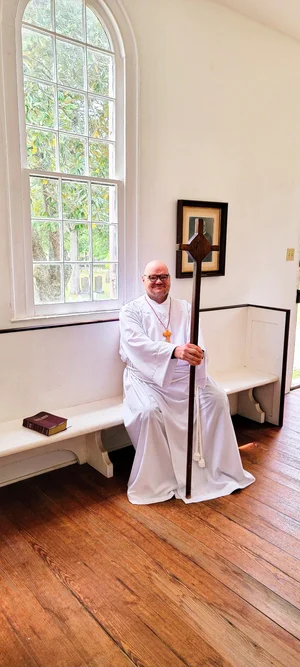
KEEP GOING: WINGATE, VOCATION, AND THE EDUCATION THAT REFUSES TO LET GO
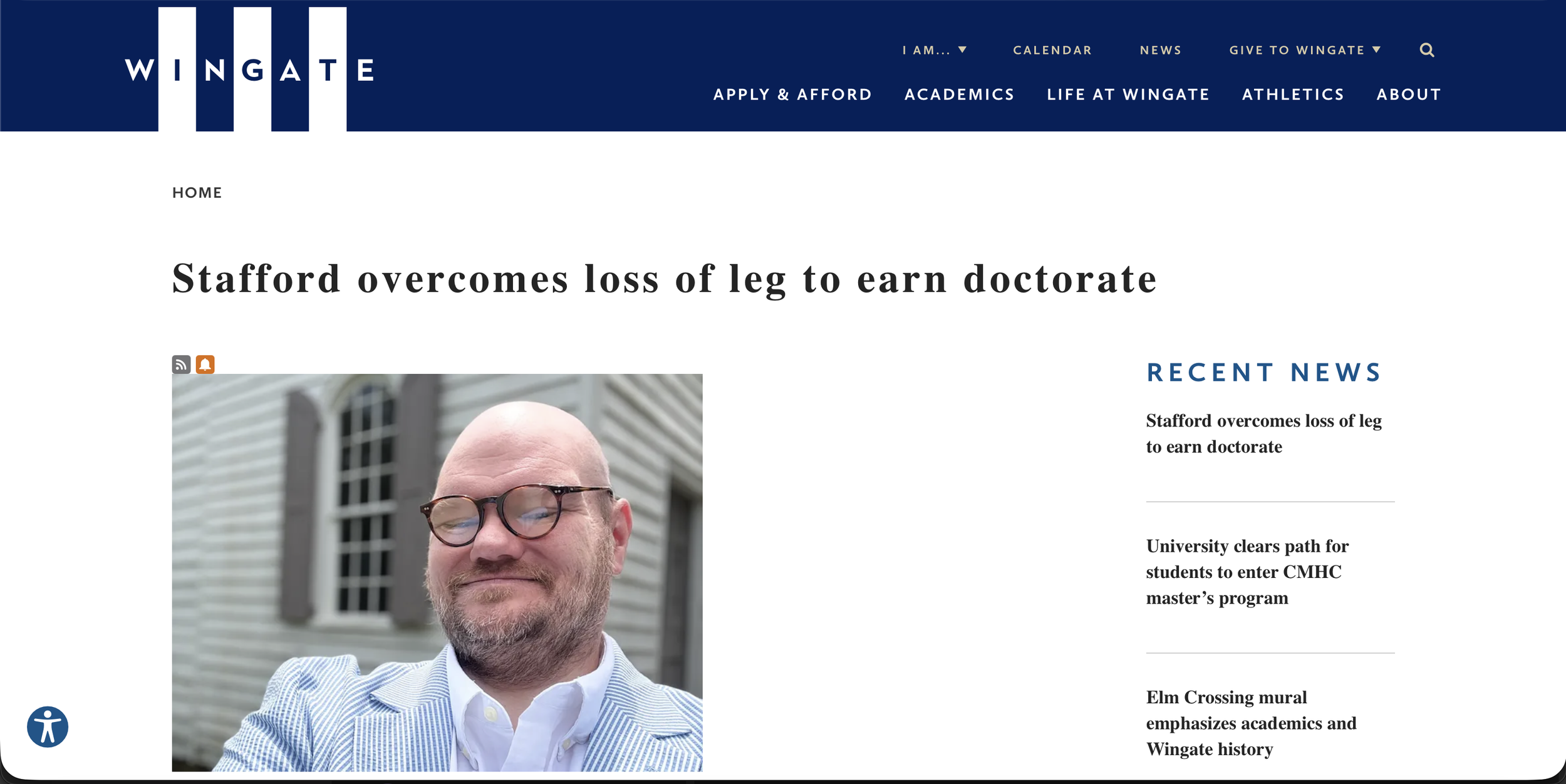
Wingate University recently published an article about my journey from history major to librarian, archivist, educator, and Doctor of Education. The headline is generous, dramatic, and the sort of thing that makes one’s inner archivist immediately want to check the metadata.
The article tells the story of earning my doctorate after losing the lower half of my left leg. It mentions the amputation, the hospital stay, the dissertation, the prosthetic leg, and my apparently unwise habit of continuing to work through circumstances that would make a more sensible person take up birdwatching.
But for me, the story is not simply about resilience. I have always been a little cautious with that word. Resilience can become a polite way of admiring people for surviving things that should have been less brutal in the first place. I did not lose a leg to become inspirational. I lost a leg because sepsis is rude, diabetes is not sentimental, and the human body occasionally behaves like a badly managed committee.
What I did do was keep going.
Wingate helped form my love of history, research, place, and story. It taught me the sacred art of paying attention. Those lessons followed me into librarianship, archival work, photography, teaching, and eventually into my dissertation: No Signal, No Success? The Internet Divide and Rural Community College Persistence.
My research focused on rural, nontraditional community college students whose persistence is shaped not by a lack of intelligence or ambition, but by unreliable internet, limited devices, economic pressure, geography, and systems not always built with their lives in mind.
In rural higher education, the digital divide is not abstract. It is a student sitting in a parking lot at night to finish an assignment. It is a timed exam interrupted by a weak signal. It is the quiet frustration of being told to “just log in” when the infrastructure will not cooperate.
Losing part of my leg also changed how I think about access. Disability has a way of making infrastructure visible. A doorway, ramp, curb, classroom, website, or learning management system either welcomes you or argues with your existence.
The same is true for digital access.
As a librarian and archivist, my vocation has always been rooted in access: access to books, records, memory, knowledge, education, and the future. Access is not a slogan. It is a structure. It is a policy. It is a design choice. It is the difference between inviting students into learning and quietly asking them to overcome barriers we should have removed.
I am grateful to Wingate University for telling this story. I am grateful for the professors who shaped me, the librarians who guided me, the students who trusted me with their experiences, and the family and friends who helped me keep going when the road became strange.
Somewhere between Dante, a hospital bed, a dissertation, and a prosthetic leg, I learned again what education has always taught me: the journey is rarely tidy, the footnotes matter, and grace often arrives disguised as work.
Read Wingate University’s article here:
https://www.wingate.edu/news-archive/news-post/~board/whats-up-at-wingate/post/stafford-overcomes-loss-of-leg-to-earn-doctorate