MRIs, Wonders of the Invisible, and a Modern Oddball
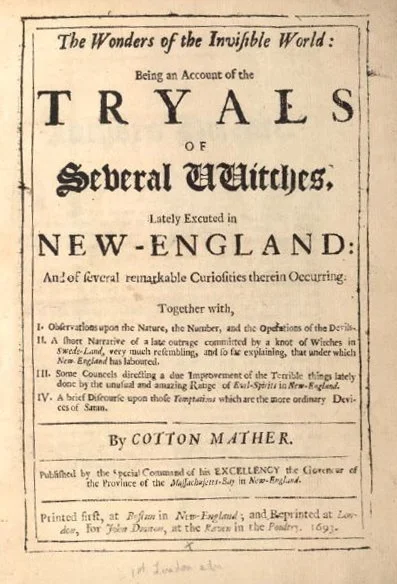
Title page of Cotton Mather’s The Wonders of the Invisible World (1693), a Puritan text born from the Salem witchcraft crisis and obsessed with what could not be easily seen: devils, spirits, hidden afflictions, and the moral terrors beneath ordinary life. A fitting image for a meditation on MRIs, modern medicine, and my apparently very specific habit of turning a medical scan into a conversation with Puritan theology.
Today I had an MRI, which is already an odd enough sentence without me making it stranger. Most people go into an MRI and think, “Please let this be over soon.” I, naturally, went into the MRI and thought about Puritans, Cotton Mather, witchcraft, and Scottish Ballet’s The Crucible.
This is very on brand for me.
The MRI machine has a very distinct sound. It is not exactly music, but it is not exactly noise either. It thumps, knocks, pulses, grinds, and hums in this strange mechanical rhythm that feels halfway between a printer possessed by demons and a percussion section trapped in a metal tube. As I lay there today, trying not to move and trying not to think too much about the fact that I was inside a very expensive medical tunnel, I placed the sound in my mind.
And then I knew where I had heard something like it before.
It reminded me of the background sound in Scottish Ballet’s The Crucible. I saw the ballet at Spoleto a few years back, and I really enjoyed it. It stayed with me, not just the choreography, but the whole atmosphere of it. The sound, especially, had this sharp, unsettling, percussive quality that seemed to hover under the movement like suspicion itself. It did not simply accompany the dance; it pressed on it. It created tension. It made the body feel watched.
Here is the video I mean: https://www.youtube.com/watch?v=1kLEJn2UgZo
That is exactly what the MRI felt like to me today. Not beautiful in the ordinary sense, but strangely dramatic. A machine making invisible things visible. A body being read by sound, magnetism, and modern science. A person lying still while the hidden interior becomes evidence.
And because my mind apparently has no normal setting, I started thinking about the Puritans.
Cotton Mather published The Wonders of the Invisible World in 1693, in the shadow of the Salem witch trials. It was a world where the invisible was not metaphorical. The unseen world was real, active, dangerous, and morally charged. Devils, spirits, temptations, providences, warnings, signs—all of it pressed into daily life. The Puritans did not live in what we would call a secular universe. They lived in a charged universe, where every illness, storm, failure, fear, or strange behavior might carry spiritual meaning.
Now, I do not admire the witchcraft hysteria. Let us be very clear: Salem was a tragedy, and the Puritan imagination could become a terrifying instrument when fear, theology, law, and suspicion joined hands. But I do find the Puritan worldview fascinating because they saw reality as layered. There was the visible world, and then there was the invisible world behind it, beneath it, and sometimes breaking through it.
So, there I was, in the MRI tube, thinking: what on earth would Cotton Mather have done with this?
Imagine trying to explain an MRI to a seventeenth-century Puritan.
“Well, Reverend Mather, this machine uses powerful magnets and radio waves to see inside the human body without cutting it open.”
He would either have fainted, written a sermon, or accused the radiology department of trafficking with familiar spirits.
Possibly all three.
Because think about it: an MRI does exactly what their imagination longed and feared to do. It reveals what is hidden. It takes the invisible interior and makes it visible. It uncovers what the eye cannot see. The Puritans searched the invisible world for devils, afflictions, signs, and secret corruptions. We search the invisible world for inflammation, infection, injury, tumors, tissue damage, and the mystery aches of being a human body that did not come with an owner’s manual.
The difference is that we call it imaging. They might have called it a wonder.
Or a warning.
Or, depending on the mood of the meetinghouse, the devil’s looking glass.
The Puritans saw Satan everywhere, or at least they believed Satan was active everywhere. To modern eyes, that can look paranoid, severe, and exhausting. And frankly, it often was. I cannot imagine trying to make it through a Monday while also wondering whether every inconvenience was a demonic plot. My Keurig fails to brew and suddenly I am in a theological crisis.
But their perspective was also unique for its time because they refused to see the material world as merely material. They believed life had spiritual stakes. They believed human beings were not just bodies moving through space, but souls moving through a battlefield of meaning. That worldview could become dangerous, especially when applied to neighbors, outsiders, women, the sick, the strange, or anyone who did not fit. But it also reminds us that people have always tried to interpret suffering. We have always tried to understand what cannot be seen.
Today, medicine does some of that interpreting for us. The MRI does not accuse. It does not preach. It does not look for Satan under the skin. Thanks be to God for that. But it does reveal hidden truths. It shows the unseen. It turns the body into an archive, layer by layer, image by image.
And that, of course, is why my librarian-archivist brain could not leave it alone.
An MRI is, in its own strange way, an archival instrument. It preserves evidence. It orders the unseen. It describes location with almost absurd precision. It says: here, not there. This tissue, not that tissue. This shadow, this signal, this structure. The body becomes a collection, and the radiologist becomes a kind of interpreter of hidden manuscripts.
Only the manuscript is me.
Which is humbling.
And a little rude.
But also miraculous.
There is something very “Ron Stafford” about lying in an MRI machine and somehow arriving at Scottish Ballet, Spoleto, Arthur Miller, Cotton Mather, Puritan theology, witchcraft, and the philosophy of the invisible. Some people count backward from one hundred. Some people imagine beaches. I apparently convene a small interdisciplinary conference in my head while magnets bang like the soundtrack to Salem.
Still, I am grateful. Grateful for the machine. Grateful for the strange music of modern medicine. Grateful for having seen a ballet that stayed tucked away in my memory until an MRI machine knocked it loose. Grateful that we live in a world where the invisible body can be seen without superstition taking over the room. And grateful, too, for the odd little connections that remind me that art, history, faith, medicine, and human imagination are never as far apart as we pretend.
The Puritans investigated the invisible world and saw devils.
Today, I investigated the invisible world by way of an MRI machine and heard Scottish Ballet.
That may not be normal.
But it is very much me.
References
Mather, C. (1693). The wonders of the invisible world. Boston, MA.
Scottish Ballet. (n.d.). The Crucible [Video]. YouTube. https://www.youtube.com/watch?v=1kLEJn2UgZo