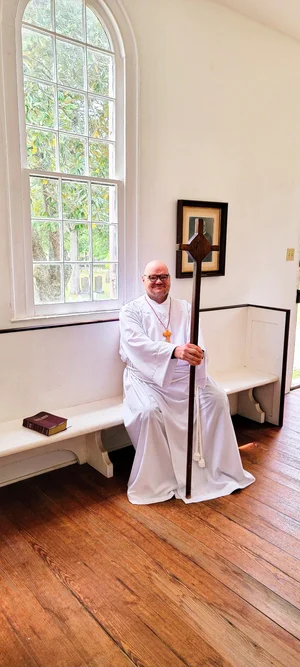
The Dark Wood and the Library Lamp: Dante, Exile, and the Soul That Keeps Reading.
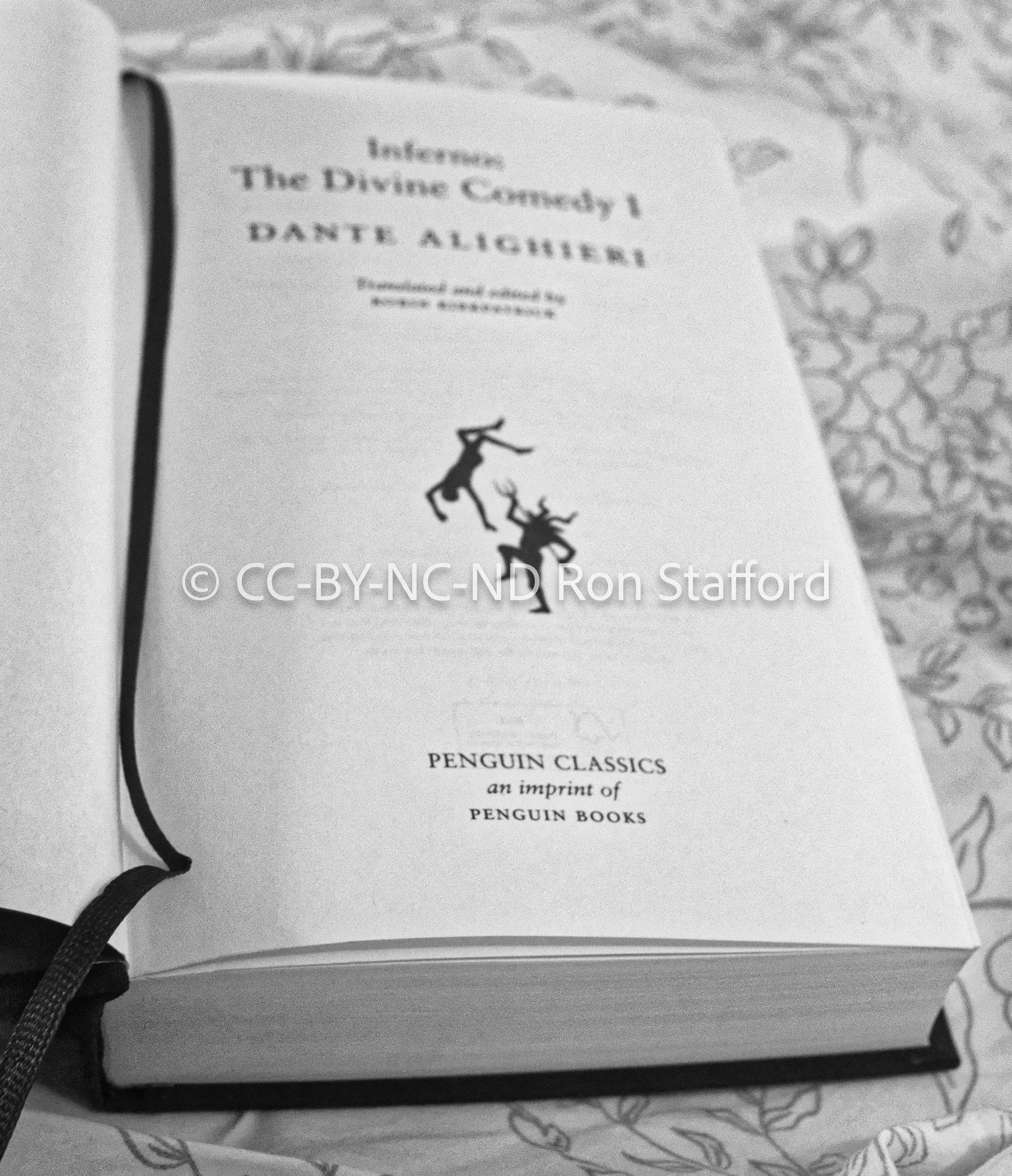
My copy of Dante’s Inferno, creased, kept close, and read like a map for the soul’s darker corridors. Some books are not merely read; they become companions through exile, prayer, scholarship, and the long walk back toward the light.
There are writers one admires, and then there are writers who move into the inner cloister of the soul, unpack their trunks, light a candle, and quietly rearrange the furniture. Dante Alighieri is that writer for me. I do not merely read Dante. I return to him. I go back the way a monk goes back to the Psalms, the way a librarian returns to a shelf whose order has become a kind of prayer, the way a wounded man returns to the road and says, with some trembling but also with stubborn grace: I am still walking.
Dante speaks to every part of me: the religious soul, the scholarly mind, and the librarian heart. He is poet, theologian, philosopher, political exile, public intellectual, and God help us all, a man with enough opinions to make even a faculty committee look serene. Stanford Encyclopedia of Philosophy describes Dante as one of the most learned Italian laymen of his age, deeply familiar with Aristotelian thought, theology, Scripture, and classical literature; his work mingles poetry, philosophy, theology, and public instruction into one vast intellectual pilgrimage (Wetherbee, 2022). That is part of why I love him. Dante does not divide the world into neat little academic cubicles. He refuses to choose between beauty and truth, between intellect and prayer, between the library and the altar. He makes them speak to one another.
For a librarian, Dante is irresistible because The Divine Comedy is, in a sense, the grandest catalog ever attempted: Hell, Purgatory, and Paradise arranged not alphabetically, thank mercy, but morally. Every soul is shelved somewhere. Every desire has a call number. Every sin has metadata. Every virtue has provenance. The poem is a vast archive of the human condition, and Dante walks through it like a pilgrim-scholar with a lantern, asking not simply, “Where are they?” but “What did they love, and what did that love make of them?”
That question feels deeply Carmelite to me. The Carmelite tradition is not sentimental about the soul. It knows darkness. It knows dryness. It knows the terrible mercy of being stripped of everything false so that only God remains. St. John of the Cross would have understood the dark wood. He would not have rushed Dante out of it with cheerful bumper-sticker theology and a casserole. He would have said, perhaps, “Yes. This is where the soul begins to learn what it has been clinging to.” Dante’s journey begins in disorientation, but it does not end there. It moves through judgment, purification, and finally vision. That is not just literature. That is the shape of conversion.
And then there is exile.
Dante’s exile from Florence was not a decorative biographical detail. It was a wound. Before 1302, he had been active in Florence’s civic and cultural life, serving in political office during a volatile period of factional conflict. When the Black Guelfs came to power, the White Guelf leadership, including Dante, was exiled; he never returned to Florence (Wetherbee, 2022). Cambridge scholarship emphasizes that Dante’s anger toward Florence and its factional politics became one of the memorable themes of the Commedia (Najemy, 1993). Another Cambridge discussion of the poem frames Dante’s condition as a “double exile”: exile from Florence and the deeper Christian exile of the soul longing for its true home with God (Barański, 2018).
That double exile is where Dante becomes painfully personal to me.
I know something about losing the map of one’s old life. I know what it is to wake up and discover that the familiar city is gone, not necessarily because one has crossed a border, but because illness, amputation, grief, and bodily limitation have made the old streets unwalkable. There are Florences we cannot return to. There are versions of ourselves that remain behind us like locked gates. Mine has included hospital rooms, wounds, prosthetics, uncertainty, and the strange spiritual discipline of learning to live inside a body that has become both companion and cross.
Dante helps me name that experience without reducing it. He does not make suffering cute. He does not put a ribbon on exile and call it “growth.” He lets exile remain exile. Yet he also shows that exile can become vocation. Cambridge’s edition of Dante’s Convivio notes that after Dante’s banishment, he turned to philosophical writing as a form of consolation for the loss of homeland and political disappointment (Lansing, 2016). That matters to me. Dante did not get Florence back. He got a poem. He got a vision. He got a road through Hell that somehow opened into stars.
There is something almost librarian-like in that holy stubbornness. The world falls apart, and still, one gathers fragments. One preserves. One orders. One reads. One teaches. One lights the desk lamp and says, “Let us see what can still be known.” My own scholarly and librarian soul understands Dante here. The library, at its best, is not a warehouse of books. It is a resistance movement against chaos. It says that memory matters. It says that language can outlive ruin. It says that even when the city burns, someone must preserve the record, not merely for nostalgia, but for resurrection.
Dante also matters to me because he believed knowledge was not ornamental. It was salvific in the broadest sense: not saving apart from God but helping the soul turn toward God. His learning was not dry accumulation. It was pilgrimage. Stanford notes that after his banishment, Dante addressed a broader Italian readership and devoted much of exile to transmitting ancient and scholastic learning in the vernacular (Wetherbee, 2022). That is the librarian’s vocation in medieval robes: to take wisdom out of locked rooms and place it where hungry souls can reach it.
That is also why Dante feels religiously alive to me. He is not merely concerned with where souls go after death. He is concerned with how desire forms us before death. What do we worship? What do we excuse? What do we refuse to forgive? What beautiful thing has become disordered in us? What truth have we avoided because it asked too much? These are not museum questions. These are morning-prayer questions. These are questions that sit beside the bed at 3 a.m. and behave with terrible manners.
Dante gives me a language for being broken but not finished. His exile did not silence him; it enlarged him. His loss of Florence became, through grace and genius, a map of the cosmos. I am not Dante, my Italian is regrettable, my political enemies are fewer, and no one has yet threatened to burn me at the stake, though I have attended meetings that came spiritually close. But I understand the ache of being separated from an old home, an old body, an old certainty. I understand the longing for restoration. I understand the scholar’s need to make meaning, the believer’s need to surrender, and the librarian’s need to keep the record straight.
So, I love Dante because he tells the truth: we begin lost. We wander. We descend. We face what we would rather leave uncatalogued. We climb. We are corrected by love. And, if grace has its way, we come at last to a light we did not manufacture.
Dante is not simply a poet I admire. He is one of the keepers of my inner library. He stands somewhere between the stacks and the sanctuary, holding a book in one hand and pointing toward the stars with the other. He reminds me that exile is not the end of the story. Sometimes exile is where the real work begins.
And sometimes, by the mercy of God, the dark wood becomes the first page of Paradise.
References
Barański, Z. G. (2018). Narrative structure. In Z. G. Barański & S. Gilson (Eds.), The Cambridge companion to Dante’s Commedia. Cambridge University Press. (Cambridge University Press & Assessment)
Lansing, R. H. (Ed. & Trans.). (2016). Dante: Convivio. Cambridge University Press. (Cambridge Assets)
Najemy, J. M. (1993). Dante and Florence. In R. Jacoff (Ed.), The Cambridge companion to Dante (pp. 80–99). Cambridge University Press. (Cambridge University Press & Assessment)
Wetherbee, W. (2022). Dante Alighieri. In E. N. Zalta & U. Nodelman (Eds.), The Stanford encyclopedia of philosophy. Stanford University. (Stanford Encyclopedia of Philosophy)