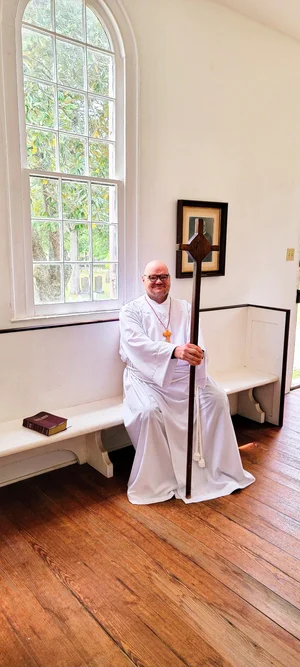
What the Doctorate Refined, Art Restored
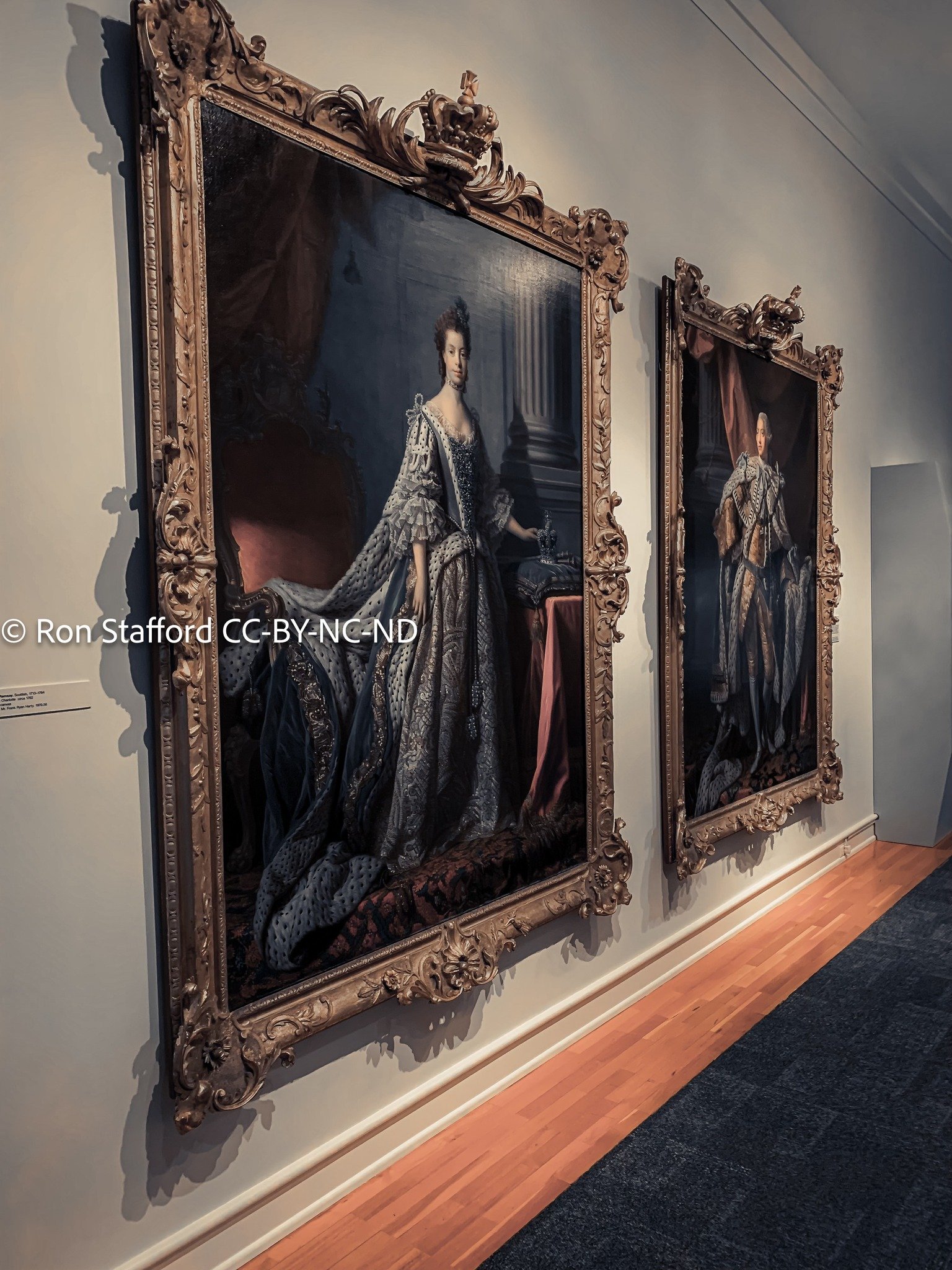
Power has always known the value of a good portrait.
Here, King George III and Queen Charlotte stand framed in the visual language of empire: velvet, ermine, columns, crowns, and the carefully staged performance of monarchy. Painted by Allan Ramsay and displayed at The Mint Museum in Charlotte, NC, these portraits remind us that art has never been merely decorative. It preserves authority, constructs identity, and invites us to look again at the complicated relationship between beauty, history, and power.
For a long time, I have thought of myself as someone who lives somewhere between the archive, the classroom, the churchyard, the museum, and the page.
I have always been drawn to words, art, history, architecture, sacred spaces, and the way memory lingers in old buildings and old stories. My brain naturally wants to wander. It wants to make connections. It wants to see how a crumbling church wall, a Virginia Woolf sentence, a Renaissance painting, a forgotten rural road, and a student’s struggle to get online might all somehow belong in the same conversation.
That is the way my mind works when it is allowed to breathe.
But when I entered a doctoral program, I had to teach my brain to work differently.
I had to move from the world of impression, beauty, metaphor, and reflection into the world of precision, structure, methodology, alignment, and evidence. I had to learn how to speak in the formal language of research. I had to stop simply saying, “This matters,” and learn how to prove that it mattered through literature, theory, data, analysis, and scholarly argument.
There is a discipline to doctoral work that is both necessary and exhausting. You do not get to float too far into the lyrical. You do not get to follow every beautiful thought down a side road. You learn to tighten your language. You learn to define your terms. You learn to justify your framework, defend your methods, align your research questions, and make sure every claim is grounded in evidence.
In many ways, I had to set aside the artsy version of myself for a season.
Not abandon him. Not erase him. But ask him to sit quietly in the corner while the researcher took the floor.
The lover of words had to become the careful writer of academic prose.
The lover of art had to become the disciplined analyst of data.
The lover of history had to become the scholar who could place a problem within a documented body of literature.
The person who wanted to write beautifully had to learn, first, to write correctly, clearly, and defensibly.
And I am grateful for that season. It sharpened me. It humbled me. It taught me that good scholarship is not just about having something meaningful to say. It is about saying it with rigor, care, honesty, and accountability.
My doctoral work focused on something that still matters deeply to me: how limited internet access affects rural community college students and their ability to enroll, persist, and succeed. That work was never just academic for me. It was about real students, real barriers, real communities, and the quiet ways inequity can shape a person’s educational future before they ever step into a classroom.
So, even while I was learning to write in formal academic language, the heart of the work remained deeply human.
Now that the program is finished, I feel something shifting in me.
I do not have to choose between the researcher and the artist anymore.
I can return to the artsy part of myself, the part that loves beauty, language, sacred spaces, photography, history, and the strange grace of old things, without giving up the discipline the doctorate gave me. I can write with both imagination and evidence. I can think with both the scholar’s structure and the artist’s eye. I can care about student access, digital equity, and higher education while still allowing myself to be moved by art, faith, memory, and place.
That feels like a homecoming.
The doctorate did not kill the artist in me. It refined him. It made him more careful. It gave him sharper tools. It taught him that beauty and rigor do not have to be enemies.
And now, I get to bring all of that with me.
I get to keep fighting for students who need access, support, and opportunity. I get to keep working for a higher education system that sees the whole student, not just the enrollment number. I get to keep speaking about rural communities, digital equity, and the barriers that too often remain invisible.
But I also get to write again as myself.
The scholar.
The educator.
The advocate.
The lover of words.
The photographer of old churches and wounded buildings.
The person who still believes that education is not only about credentials, but about transformation.
For a season, I had to become hyper-focused. I had to learn the language of the academy. I had to do the hard, formal, disciplined work.
Now, I get to carry that work forward with my whole self-restored.
And maybe that is the gift of finishing: not that you become someone entirely new, but that you finally get to gather all the scattered parts of yourself and say, “Yes, all of this belongs.”